In Short
Green beans get their grassy flavor from C6 aldehydes, which pair best with acidic fats, deep umami, and toasted nuts. The exact chemistry of these pairings (and why nutmeg is the unexpected spice you should be using) is below.
You have probably stared at a pile of green beans and wondered what to do besides tossing them in butter. They are an interesting vegetable, chemically speaking. They carry a very specific, watery crispness that easily gets lost if you do not anchor it properly. To make them taste like more than just hot grass, you have to understand the compounds that give them their flavor in the first place.
Cooking them is a balancing act. They are sturdy enough to handle high heat, yet their delicate nature can easily be steamrolled by heavy sauces. Once you figure out the chemical interactions that make them tick, mastering green bean pairings becomes second nature. You can open your pantry and immediately know what will work and what will clash.
Wait, Why Do They Taste So Grassy?
If you bite into a raw green bean, you get a sharp, almost metallic green flavor. This is driven largely by volatile compounds formed from fatty acids. Specifically, C6 aldehydes like hexanal, and alcohols like 1-octen-3-ol, are the major players here (Journal of Food Science, 1978). These are often collectively referred to as green leaf volatiles. They are created when an enzyme called lipoxygenase breaks down fatty acids inside the plant tissue.
When you cook the beans, some of these compounds begin to break down and volatilize. The heat softens that raw edge into a sweeter, milder flavor. This is why a perfectly blanched green bean tastes pleasantly fresh, while an undercooked one tastes like a lawnmower blade.
But green beans are essentially a blank canvas of water and fiber. A 100-gram serving (USDA FoodData Central) has just 31 calories, 1.8 grams of protein, and a microscopic 0.2 grams of fat. They simply do not contain the macronutrients required to coat the palate or trigger a strong savory response in the brain.
Because they lack natural fat and savory amino acids, they rely entirely on what you pair them with to feel complete. The trick is to balance those grassy aldehydes without burying them completely. You want to complement the hexanal, not pretend it does not exist.
The Fat and Acid Trick
Fat coats the tongue, which helps mask the slight astringency of the raw vegetable. Acid slices right through that fat while brightening the remaining green notes. It is a fundamental culinary mechanism that works on almost any vegetable, but it is especially crucial for green beans.
Butter and lemon are the classic example of this bridge. The dairy solids in butter mellow out the sharp hexanal. A squeeze of lemon juice provides a high-note contrast that mimics the bean's natural freshness. Adding acid directly to green beans while they cook will react with their chlorophyll, turning them a drab olive color. Squeezing the lemon on right before serving prevents this completely.
Bacon fat mixed with a splash of apple cider vinegar operates on the exact same logic. You are just swapping a dairy fat for a pork fat, and a citrus acid for an acetic acid. This heavier combination works beautifully for slow-braised Southern-style beans. In that scenario, the extended cook time has already destroyed the bright green color and you are leaning into deep, earthy comfort instead.
A quick weeknight side comes together by tossing a pound of blanched beans with a tablespoon of melted butter and a teaspoon of lemon juice. If you are using olive oil instead of butter, a grassy, peppery oil will naturally harmonize with the bean's own green beans flavor profile.
Filling the Umami Gap
Since green beans have very low levels of naturally occurring glutamates, they desperately need a savory boost. Without umami, they can taste watery and hollow, even if you salt them properly.
Anchovies are brilliant for filling this gap. Melting a few anchovy fillets into warm olive oil over medium heat causes the fishiness to dissipate entirely. What is left behind is pure savory depth. The natural sweetness of the cooked green beans intensifies when it rubs up against the complex salt and umami of the fish. This pairing works perfectly for a quick blistered green bean dish, though it fails if you are boiling the beans, as the water will just wash the flavored oil away.
Parmesan cheese does the same heavy lifting for those who prefer to skip seafood. Grating Parmesan over hot beans melts it just enough to cling to the pods. This delivers a massive hit of glutamic acid.
Soy sauce or a dash of fish sauce splashed into a wok during a stir-fry will also accomplish this. You only need a small amount — maybe two teaspoons per pound of beans. Adding too much soy sauce turns the beans into a salty, gray mess and completely masks the delicate green leaf volatiles. The goal is to support the vegetable, not drown it.
The Magic of Toasted Nuts
Green beans and toasted almonds (often called green beans amandine) is a French bistro staple. There is a very specific chemical reason this combination has survived for decades.
Fresh green beans are full of water and light, grassy volatiles. Toasted nuts are entirely different. When you toast almonds, hazelnuts, or sesame seeds, the heat triggers the Maillard reaction (which typically begins around 285°F). This process creates complex, earthy aroma compounds called pyrazines and furans.
Pairing them together creates a perfect textural and chemical contrast. You get the snappy, wet crunch of the vegetable against the dry, brittle crunch of the nut. The earthy pyrazines ground the flighty green aldehydes. This makes the flavor profile feel round and complete.
This is easily replicated by dry-toasting a handful of slivered almonds in a skillet for three to four minutes until fragrant. Tossing them with cooked beans right before plating ensures they do not absorb moisture and lose their crunch. This works wonderfully for quick-cooked dishes, but it fails completely in a slow-cooker scenario where the nuts would turn to mush.
A Quiet Case for Nutmeg
Most people reserve nutmeg for baking or heavy cream sauces. When looking for spices for green beans, it is actually one of the best options available. It catches people off guard in the best way possible.
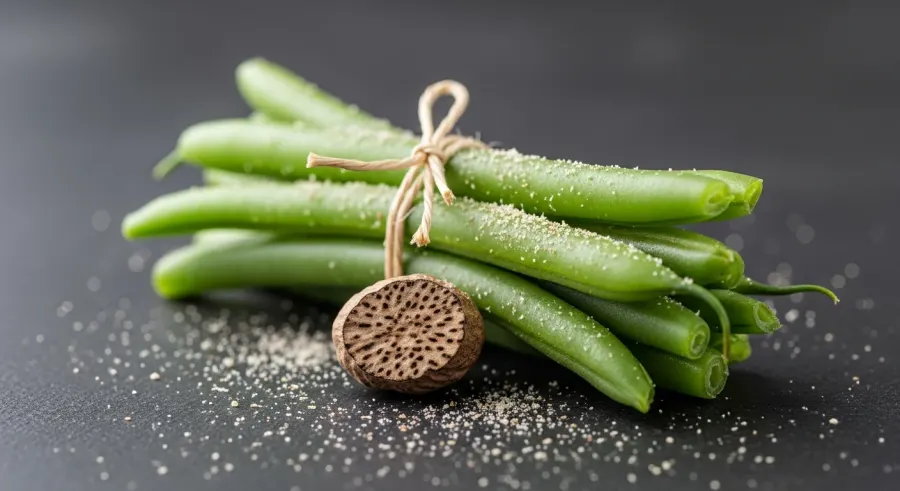
Nutmeg contains an aromatic compound called myristicin, which carries warm, woody, and slightly sweet notes. When you dust freshly grated nutmeg over green beans, it acts as a background warmer. It does not make the beans taste like a dessert. Instead, it rounds out the sharp vegetal edges and makes the dish feel cozy and complex.
This pairing fails if you use pre-ground nutmeg that has been sitting in a drawer for three years (at that point, it just tastes like dusty sawdust). A few light scrapes of a whole nutmeg pod over butter-tossed beans is subtle and highly effective.
A tiny pinch of cinnamon can work in a similar way, though cinnamon leans a bit sweeter and can easily overpower the dish. A fraction of a teaspoon is plenty.
The Garlic and Onion Bridge
Garlic and shallots are the default pairing for a reason. They bridge the gap between savory cooking fats and fresh plant matter.
Garlic is packed with sulfurous compounds like allicin, which sweeten and mellow out when cooked gently. Shallots do the same thing, though they bring a higher natural sugar content. This mirrors the subtle sweetness of a properly cooked snap bean.
The main issue people run into here is timing. A home cook will often throw minced garlic into a hot pan at the exact same time as raw green beans. The beans need several minutes of heat. The garlic burns in forty seconds.
Cooking the beans entirely first solves this. You just sauté the garlic or shallots in oil for thirty seconds until fragrant, then toss the pre-cooked beans in the flavored oil to coat. Two cloves of garlic or one small shallot is plenty for a standard pound of beans.
Fresh Herbs and Floral Notes
Green beans take exceptionally well to fresh herbs, provided you understand which compounds you are mixing.
Basil is a phenomenal match. It contains linalool, which brings a sweet, floral aroma, and eugenol, which carries a warm, clove-like background. Tossing warm green beans in a spoonful of pesto or just tearing fresh basil leaves over the top softens the grassy impact of the beans. The sweetness of the basil leans into the natural sugars of the vegetable.
Mint and tarragon also work beautifully, though for different reasons. Mint provides a cooling sensation that highlights the crisp, refreshing qualities of a blanched bean. Tarragon brings a distinct anise or licorice flavor. This works best when paired with a fat like butter or a light cream sauce, as the fat carries the fat-soluble flavor compounds of the tarragon across your palate.
The rule with herbs is timing. If you cook fresh basil or mint for ten minutes alongside the beans, the delicate aromatic oils will completely evaporate. You will be left with black, tasteless leaves.
Using Heat as a Distraction
Sometimes, you want to mask the bean's vegetal notes rather than highlight them. This is where heat comes into play.
Red pepper flakes, chili crisp, or even a dollop of sharp Dijon mustard interact directly with the pain receptors on your tongue. Capsaicin (from the chilies) and allyl isothiocyanate (from the mustard) provide a sharp, vibrating heat that distracts the palate from any lingering metallic or raw flavors in the bean.
This is particularly useful if you are working with slightly older, tougher green beans that have developed a harsh, almost bitter profile. Tossing them in a spoonful of chili crisp right before serving coats them in savory oil and fiery aromatics. The crunch of the chili flakes also mirrors the crunch of the vegetable.
Mustard works on two levels. Not only does it bring heat, but it acts as a powerful emulsifier. If you are making a cold green bean salad, a vinaigrette bound together with a teaspoon of Dijon mustard will cling perfectly to the waxy exterior of the pods.
Bottom Line
A great side dish requires nothing more than picking a fat, finding a source of umami, and adding a little acid at the end. Once the chemistry makes sense, the rest is just personal preference.