In Short
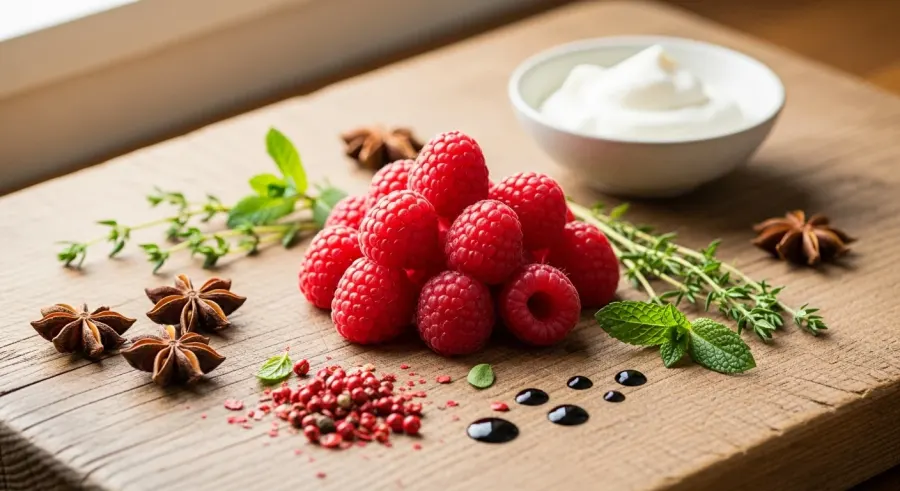
Raspberries pair best with fatty meats like duck and pork, rich dairy like goat cheese, dark chocolate, tree nuts, ginger, and piney herbs like thyme. The biochemical reason why ginger works so well—and why dairy completely changes the berry's flavor—comes down to a few shared molecular structures.
Raspberries are a strangely complex fruit. If you bite into one, you get the sharp, bright acidity of a citrus fruit, but the aroma is built on powdery, floral compounds that actually resemble violets and roses. Figuring out what flavors go with raspberries is really just about balancing that aggressive tartness, while giving those quiet floral notes a place to land without getting lost.
Duck and pork need the acid
Chicken breast doesn't quite have the fat density to stand up to a heavy raspberry reduction; the acid just overpowers the mild meat. Duck breast and pork shoulder, however, have deep reserves of fat. When you eat them, lipid compounds coat your palate.
Raspberries sit at a highly acidic pH, usually between 3.2 and 3.9, according to the FDA. That acidity acts as a mechanical palate cleanser, slicing right through the richness. Plus, when you roast these meats, the Maillard reaction creates savory, browned compounds on the crust. Those deep, roasted flavors contrast sharply with the bright, volatile esters in the berries.
A simple application involves reducing a handful of crushed berries with a splash of balsamic vinegar for ten minutes to form a loose glaze, which cuts the fat of a roasted pork chop. The vinegar adds acetic acid, which layers with the malic acid of the berries to create a much rounder tartness.
The weird molecular link to ginger
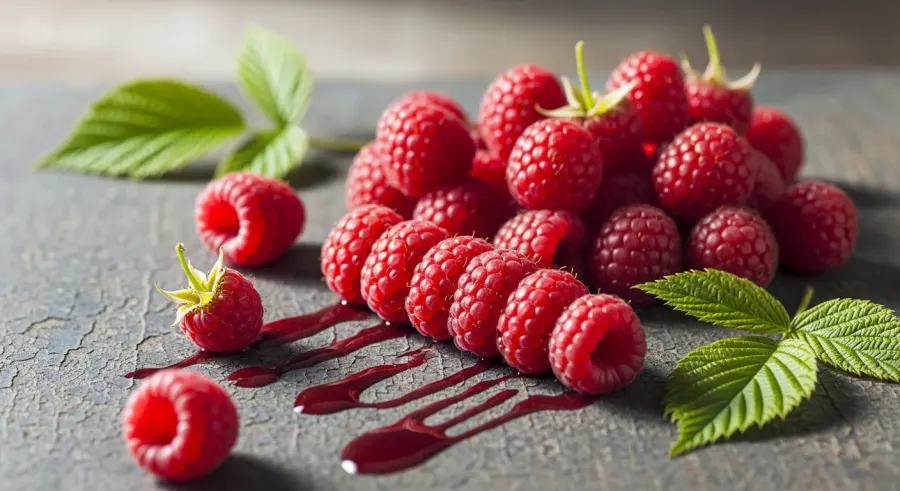
If you are wondering what pairs well with raspberries on a chemical level, ginger is the answer. Did you know raspberries and ginger are practically chemical cousins? The signature scent of raspberries comes from a compound called raspberry ketone. The warming, pungent bite of ginger comes from a compound called zingerone.
Look at them under a microscope, and they are almost identical—zingerone just has one extra methoxy group attached to its ring structure. Because they share this underlying architecture, they amplify each other. The heat of the ginger makes the berry taste juicier, while the berry softens the aggressive bite of the spice.
This works beautifully in raw applications, but heat changes the dynamic. If you cook ginger and raspberries together for too long, the volatile aromas cook off and you are left with a flat, earthy sweetness. Grating a tiny bit of fresh raw ginger into a bowl of macerated raspberries and letting it sit for twenty minutes shows off this interaction perfectly.
Dairy makes the floral notes pop
Eating a raspberry entirely on its own means the tartness usually hits you first. That sharp citric and malic acid can actually hide the fruit's more delicate aromas. Raspberries contain alpha- and beta-ionones, which are the exact same compounds that give violets their distinct, powdery scent (Journal of Agricultural and Food Chemistry, 2005).
When you pair the berries with a high-fat dairy like ricotta, mascarpone, or mild goat cheese, the milk fat coats your tongue. This creates a physical barrier against the acid. Suddenly, you stop tasting the sourness and start noticing the rose and violet notes.
Avoid using heavily aged, sharp cheeses like a dry provolone or an intense blue. The high salt content and pungent fermentation notes will completely bury the subtle ionones. You want a fresh, high-moisture cheese. Folding a few berries into a cup of whole-milk ricotta demonstrates this effect, as the fat mutes the acid and brings the floral aromatics forward.
Almonds and hazelnuts just work
Almonds naturally contain benzaldehyde, the compound responsible for that distinct, cherry-like marzipan aroma. Hazelnuts bring toasted pyrazines to the table. Both of these nut profiles anchor the airy, fleeting fruitiness of a raspberry.
The berry provides the top notes, while the nuts provide the bass. If you are baking, swapping standard flour for almond meal in a raspberry cake changes the entire structure of the flavor.
Raw almonds offer a very mild, milky contrast, but roasting them is what actually activates those deeper savory compounds. Walnuts and pecans, on the other hand, contain high levels of tannins in their skins. Mixing those tannins with the acidity of a raspberry can create a harsh, mouth-drying astringency. Toasting a handful of slivered almonds in a dry pan for three minutes until fragrant, then scattering them over fresh berries, is a much safer bet.
Dark chocolate is a balancing act
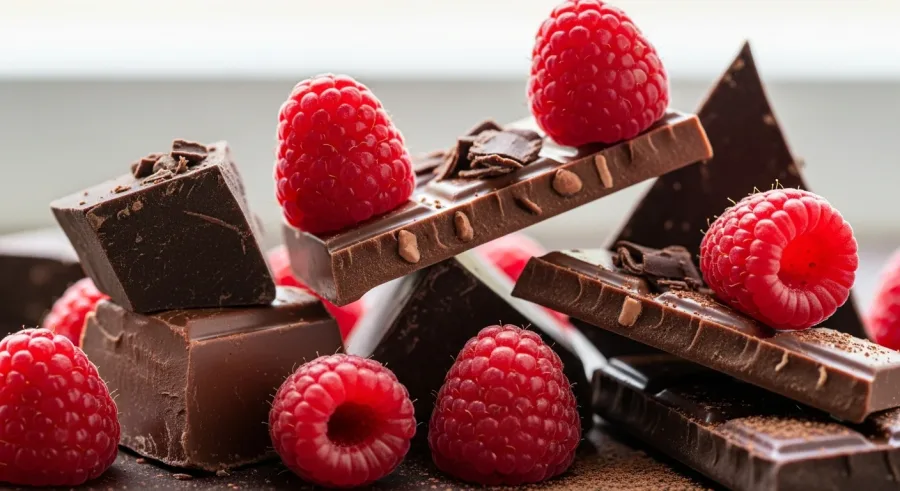
White chocolate gets paired with raspberries often, but dark chocolate above 70% cacao is where the real interaction happens. Cacao introduces a heavy dose of bitterness and astringency.
This bitterness tricks your palate into perceiving the raspberry as sweeter than it actually is. The roasted notes of the chocolate also ground the bright, jammy qualities of the fruit. This dynamic works perfectly for dense brownies or a rich ganache.
Skip the milk chocolate if you want this specific contrast—the added sugar in milk chocolate muddies the waters and makes the whole pairing cloying. A 75% dark chocolate has just enough cocoa butter to mellow the berry's citric bite, without dumping unnecessary sucrose into the mix.
Fresh thyme actually makes sense
It sounds strange to put savory herbs on a delicate berry. Flavor matching, however, often comes down to shared volatile compounds. Both raspberries and herbs like thyme and rosemary contain linalool and pinene.
These terpenes are present in both the herbs and the complex raspberry flavor profile, creating a subtle, piney, and floral bridge between the two ingredients. The earthiness of the thyme pulls the raspberry out of the dessert category and into savory applications.
Woody herbs like rosemary need to be used sparingly, as their high essential oil content can easily taste medicinal when paired with fruit. Soft herbs like basil or mint offer a much safer, cooler contrast, but they lack that specific piney architecture. Tossing fresh raspberries with a little finely chopped thyme and flaky salt creates a sharp, unexpected side dish for roasted vegetables.
Vanilla softens the sharp edges
Vanilla is often treated as a background ingredient, but when paired with raspberries, it acts as an active flavor modulator. Natural vanilla is dominated by vanillin, a phenolic aldehyde. Structurally, vanillin is remarkably close to raspberry ketone—they belong to the same broader family of compounds.
When you combine them, the vanilla doesn't just add a sweet aroma; it actually alters how your brain perceives the berry's acidity. The heavy, woody notes of a real vanilla bean trick the palate into registering the tart malic acid as something much softer and rounder.
This interaction is highly situation-dependent. If you use synthetic clear vanilla extract, you often get a harsh, alcohol-forward flavor that clashes with the fresh fruit. Scraping the caviar from half a vanilla bean into a raspberry puree utilizes the fat from the bean's natural oils to bind with the fruit's volatile esters, creating a cohesive, jammy profile.
Bottom Line
Building successful raspberry flavor pairings rarely comes down to magic. It is usually just a matter of matching molecular structures or finding the right fat to mellow an aggressive acid. Once you realize raspberries are just a collection of floral compounds wrapped in a tart, low-pH package, it becomes a lot easier to figure out what belongs on the plate with them.