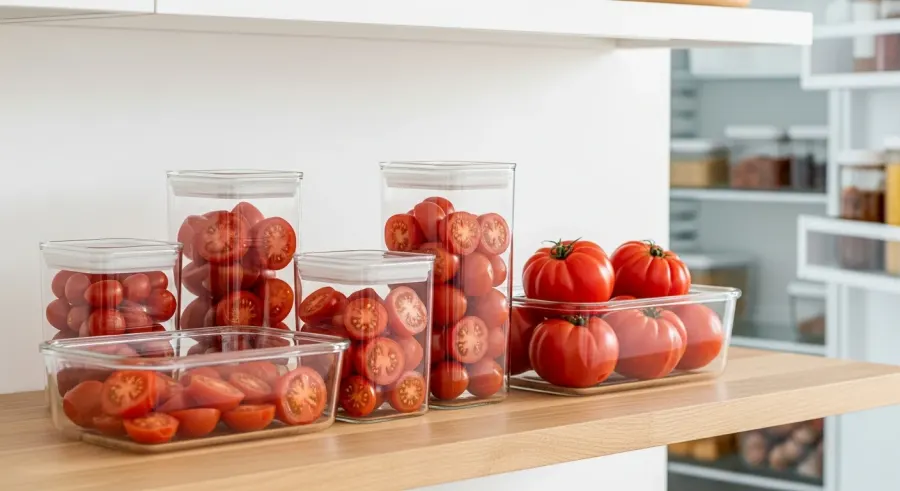
In Short
Keep unripe tomatoes on the counter at room temperature, but move fully ripe tomatoes to the fridge to extend their shelf life. The exact temperatures that permanently destroy flavor (and the physical trick that makes countertop tomatoes last twice as long) are explained below.
Figuring out how to store fresh tomatoes usually triggers an intense debate about the refrigerator. The reality of postharvest biology is far more nuanced than strict kitchen rules suggest. Preserving the perfect texture and summer flavor profile depends entirely on matching your storage environment to the exact ripeness of the fruit.
The Great Refrigerator Debate
There is a persistent kitchen rumor that a tomato should never, under any circumstances, see the inside of a refrigerator. People defend this rule with serious passion, but the underlying science is highly dependent on timing. Tomatoes are climacteric fruits. This means they continue to ripen after they leave the vine, driven by the invisible release of ethylene gas. The critical tomato storage temperature threshold for this entire operation is 55°F (13°C). Dropping below this specific mark triggers a biological failure known as chilling injury.
A fascinating discovery published in the Proceedings of the National Academy of Sciences (2016) mapped exactly how this happens. The researchers found that DNA methylation increases during cold storage, altering the transcription of genes responsible for synthesizing enzymes like lipoxygenase. These are the exact enzymes that convert the raw material in the tomato into the complex esters, aldehydes, and ketones that we perceive as true tomato flavor. Without them, the fruit tastes flat and watery. The most critical part of this discovery is that even after the tomato is brought back to room temperature, the down-regulation of several key flavor-producing genes does not recover. If an unripe tomato spends time in the fridge, it might eventually turn red on the counter, but its internal flavor factory remains permanently shut down.
Getting Countertop Storage Right
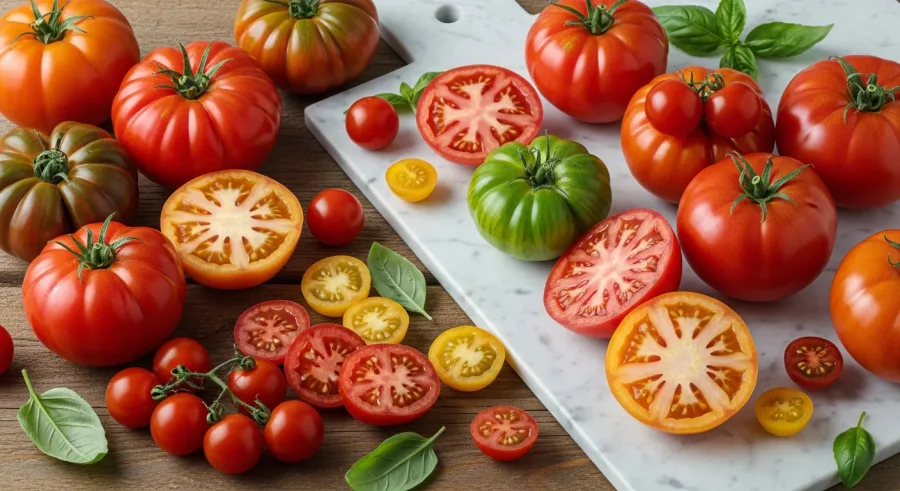
Room temperature is a surprisingly specific metric in food science. When assuming that unripe tomatoes belong on the counter, the ambient environment needs to sit between 65°F and 70°F (18°C to 21°C). This narrow window is where the ripening enzymes operate at peak efficiency. Dropping below 60°F (15°C) makes the process sluggish, while rising above 75°F (24°C) causes the fruit to respire too quickly, burning through its stored sugars and drastically shortening its shelf life.
Direct sunlight is a common hazard in countertop storage. Placing tomatoes on a sunny windowsill feels like a natural way to mimic the vine, but the window glass amplifies the heat. This intense localized warmth often pushes the internal temperature of a tomato past 85°F (29°C), which halts the synthesis of lycopene. Instead of a deep, uniform red, the heat-stressed skin develops a mottled, yellowish-orange finish.
Airflow is another major factor. Tomatoes have high respiration rates, meaning they constantly exchange gases with their environment. Trapping them in sealed plastic containers or heavy glass jars accelerates anaerobic respiration. This leads to internal moisture buildup and rapid fungal decay. A simple open plate or a shallow wire basket provides the necessary circulation. Under these ideal ambient conditions, an underripe tomato will usually reach maturity within three to seven days.
Wait, Why Store Them Upside Down?
The calyx scar—the tiny, jagged indent at the top of a tomato where it detached from the stem—is the most vulnerable part of its anatomy. The outer skin of a tomato is a thick cuticle coated in natural wax, which is highly effective at retaining water. The only significant break in this armor is that stem scar, exposing the internal vascular tissues to the air.
In postharvest physiology, this porous area acts as a gateway for both moisture escape and microbial invasion. When a tomato sits stem-side up, the dry indoor environment acts like a sponge, pulling water vapor straight out of the top of the fruit. This steady transpiration is what causes the skin to develop sad, localized puckering after just a few days on the counter.
The logic behind storing tomatoes upside down comes down to simple physics. Flipping the tomato over so the scar rests flat against a plate creates a physical barrier. It minimizes the air flow around the calyx, effectively plugging the microscopic hole. Observations show that tomatoes stored stem-side down lose significantly less of their water weight over a few days compared to those stored stem-side up. This mechanical trick easily extends countertop life by an additional three to four days.
When the Fridge Actually Makes Sense
There is exactly one scenario where the cold environment is beneficial, and it depends entirely on the ripeness of the fruit. A perfectly ripe, deeply colored heirloom tomato will quickly turn to mush if left on a warm countertop. At this peak stage, you can absolutely refrigerate ripe tomatoes to protect their structural integrity.
Because the tomato has already produced its complete profile of flavor volatiles, the cold environment (typically around 40°F or 4°C) acts as a pause button rather than a disruption. The chill suppresses the activity of polygalacturonase, the specific enzyme responsible for breaking down pectin in the cell walls. This halting of pectin degradation keeps a chilled tomato firm, buying you up to five extra days of viability with minimal damage to the sensory profile.
The critical element of this method is the recovery phase. A cold tomato has restricted volatile compounds, meaning they lack the thermal energy to evaporate into your nasal cavity when you take a bite. The recovery process requires leaving the fruit out on the counter for about an hour before eating. Warming up allows the existing aromatic compounds to volatilize again, restoring the complex taste that the low temperatures temporarily masked.
Freezing for December Soups
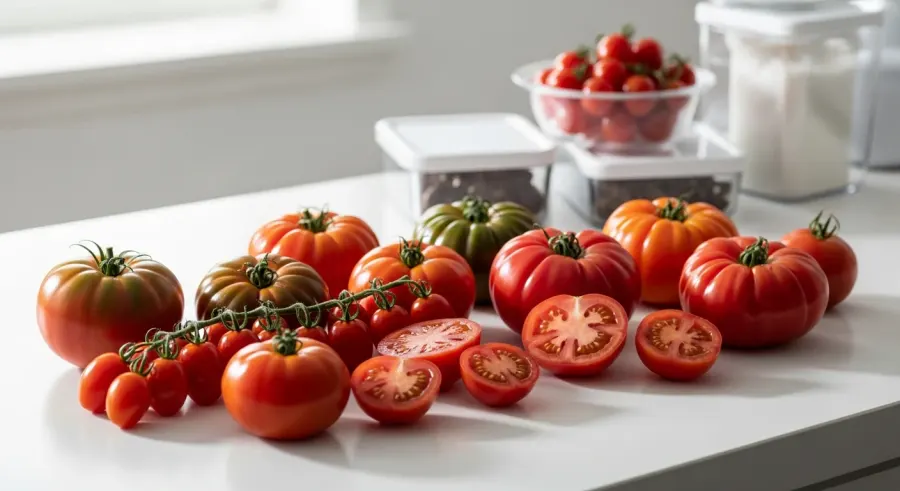
Sometimes late summer gardens produce twenty pounds of fruit all at once, far exceeding what can be eaten fresh. The process of freezing fresh tomatoes is highly effective, provided the structural consequences are fully understood. A ripe tomato is roughly 94% water by weight, contained within rigid cell walls made of delicate cellulose.
When subjected to the 0°F (-18°C) temperatures of a standard home freezer, that internal water expands into large, jagged ice crystals. These crystals act like microscopic daggers, piercing through the cellulose walls from the inside out. As long as the tomato remains frozen, the ice acts as a structural support. But the moment the tomato thaws, the shattered cell walls simply collapse, leaving a puddle of liquid and a flaccid, weeping skin.
Because of this severe cell lysis, frozen tomatoes are strictly reserved for the cooking pot. If the end goal is a marinara or a winter chili, this structural breakdown is actually an advantage since the tomatoes essentially purée themselves. The easiest processing method involves washing and coring the fresh fruit, then arranging them on a parchment-lined baking sheet. This individual freezing prevents them from fusing into a solid block. Once frozen solid, they easily transfer to a heavy-duty bag where they will remain viable for six to eight months.
How to Spot a Genuinely Bad Tomato
Spoilage is rarely a mystery, but identifying the early visual and olfactory signs prevents a single compromised tomato from ruining the rest of the batch. The most common culprits are fungal pathogens like Botrytis cinerea (gray mold) and Alternaria alternata (black mold). These don't appear randomly; they exploit physical weaknesses, almost always colonizing at the stem scar or inside microscopic cracks in the cuticle caused by rough handling.
The first visible sign of Alternaria is a dark, sunken lesion that feels significantly softer than the surrounding flesh. If white or gray fuzz begins developing on the surface, Botrytis is actively producing spores. Because tomatoes have such a high moisture content, the mycelial threads of the mold penetrate deep into the interior long before the surface fuzz becomes visible, meaning the affected spots cannot simply be carved away.
Textural and chemical changes also signal the end of a tomato's usable life. Chilling an unripe tomato doesn't alter its baseline profile—providing about 18 calories, 0.88g of protein, 0.2g of total fat, 0.03g of saturated fat, 3.89g of carbohydrates, 1.2g of fiber, 2.63g of sugar, and 5mg of sodium per 100g (USDA FoodData Central)—but it does permanently halt the synthesis of lycopene, an important antioxidant. If the physical structure collapses entirely and emits a sharp, sour odor, naturally occurring yeasts have begun converting the internal sugars into ethanol. A fermented smell indicates the fruit is completely compromised.
Bottom Line
Understanding proper storage is mostly a matter of observing the fruit's current stage of life. Paying attention to temperature thresholds and respecting the delicate nature of the stem scar makes the transition from the vine to the cutting board much smoother.