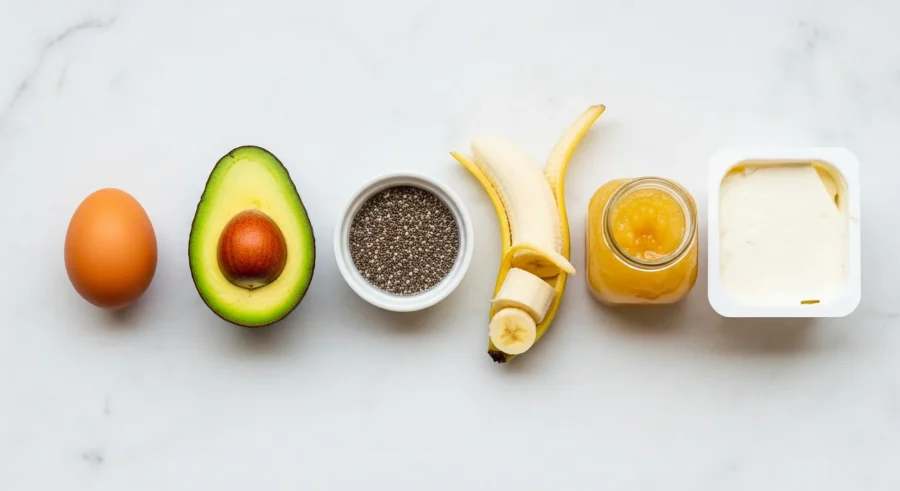
In Short
Aquafaba provides the best lift for light sponge cakes, while pureed silken tofu is ideal for adding dense moisture to chocolate cakes. Which one you choose depends entirely on whether your cake needs the egg for trapping air, building structure, or emulsifying fat.
Baking a cake without eggs feels a bit like removing the foundation from a house. A whole egg is roughly 75 percent water, but that remaining 25 percent is a complex mix of protein and fat that traps air, emulsifies batter, and sets the crumb. Replacing that perfectly calibrated little orb requires matching your substitute to the specific job the egg was doing in your recipe.
The Chickpea Water Trick
The murky liquid sitting in your can of chickpeas is technically called aquafaba. It behaves so much like egg whites that bakers use it to make meringue, but it also functions as a highly effective binder and aerator in cake batters.
For a standard cake, you use three tablespoons (45ml) of aquafaba to replace one whole egg. If a recipe specifically calls for an egg white, you drop that to two tablespoons.
The science behind this relies on the unique composition of the cooking water. During the canning or boiling process, proteins, starches, and naturally occurring plant compounds called saponins leach from the chickpeas into the water. Saponins act as natural surfactants. When you whip aquafaba, these compounds lower the surface tension of the liquid, allowing it to trap air bubbles and create a stable foam. Food science research highlights that aquafaba exhibits foaming and emulsifying properties that closely rival traditional egg whites.
This foaming action is highly useful for white layer cakes, light sponge cakes, or any recipe that requires significant aeration. You can use a hand mixer to whip the aquafaba until soft peaks form, just as you would with egg whites, before gently folding it into your dry ingredients. The protein network created by the saponins is delicate, so aggressive stirring will deflate the bubbles.
A whole egg contains roughly 10g of fat and 12g of protein per 100g, according to USDA FoodData Central. Aquafaba, on the other hand, contains almost zero fat and barely 1g of protein. Because of that missing fat, the flavor stays completely neutral once baked. You will not taste beans in your vanilla cake.
However, the lack of fat is also its main failure point. A cake crumb relies on fat for tenderness. If you try to use aquafaba to replace the eggs in a rich pound cake, the resulting crumb will turn out dry and slightly tough. It needs an environment where structure and lift are the main goals, and where the recipe already provides plenty of other fats like butter or oil to compensate.
Why Silken Tofu Rarely Fails
Some cakes just need moisture and a bit of weight. Silken tofu provides both, plus enough protein to help the cake set properly in the oven. It is a quiet workhorse in vegan baking.
You puree the tofu in a food processor or blender until it is completely smooth, then measure out one-quarter cup (about 60g) to replace one whole egg.
Tofu is roughly 85 percent water by weight. USDA FoodData Central notes it brings about 4.4g of protein and 2.2g of fat per 100g. When the cake batter heats up, the soy proteins undergo thermal coagulation. This directly mimics the way animal egg proteins firm up, giving the cake structural integrity as the starches gelatinize. Silken tofu also contains natural lecithin, which acts as an emulsifier to help the fat and water in your batter blend smoothly.
Make sure the tofu is at room temperature before blending. Cold tofu can cause melted butter or coconut oil in your batter to seize up, leaving you with little clumps of solid fat rather than a cohesive emulsion.
The flavor is practically undetectable. It adds no sweetness, leaves no savory aftertaste, and does not compete with vanilla extract or cocoa powder.
This makes pureed tofu an excellent choice for dense, heavy batters like chocolate mud cake, red velvet, or fudgy brownie-like cakes. The extra moisture it brings to the table keeps the crumb soft for several days after baking.
Angel food cake is the exact wrong place for tofu. The sheer weight of the puree will collapse a delicate batter. Tofu provides density, not lift. If the recipe requires you to separate eggs and whip the whites to stiff peaks, replacing them with tofu will leave you with a rubbery, flat brick instead of a cake.
Starch Powders That Bind Everything
Commercial egg replacers look like simple white powders, but they are carefully formulated binders. Brands like Bob's Red Mill usually blend a specific ratio of potato starch, tapioca flour, baking soda, and psyllium husk fiber.
You mix one tablespoon of the powder with two tablespoons of warm water, let it sit for a minute to thicken, and use that slurry to replace a single egg.
The mechanism here is purely carbohydrate-based. The water temperature matters. Using warm water helps the potato and tapioca starches hydrate faster, preventing dry pockets of powder from forming in the bowl. The starches absorb the water and swell, creating a thick gel that holds the other ingredients together in suspension. Meanwhile, the psyllium husk provides a fibrous network that mimics gluten or egg protein strands, and the baking soda provides a tiny amount of chemical lift to offset the density of the starches.
These powders are perfectly flavorless. They disappear completely into the background of whatever you are baking.
They are highly reliable for standard vanilla cupcakes, basic yellow cakes, or sheet cakes where you just need the batter to hold its shape. If you are baking a box mix without eggs, this is usually the safest substitute to reach for.
There is a distinct limit to what starch can do. These commercial mixes contain zero grams of fat and zero grams of protein per serving. A cake that relies heavily on the emulsifying power of egg yolk lecithin to blend butter and water will struggle. The resulting cake might taste perfectly fine, but the crumb can end up slightly fragile and crumbly when you try to slice it, simply because there is no protein network holding the walls of the air bubbles together.
Fruit Purees Usually Make It Gummy
Using mashed banana or applesauce is one of the oldest substitution tricks around. It was popularized during periods of rationing and remains common today simply because most people already have fruit on their counter.
A quarter cup of smooth puree replaces one whole egg.
The natural pectins and complex carbohydrates in the fruit trap moisture effectively, which keeps the baked cake soft. The fruit also acts as a physical thickener, adding viscosity to the raw batter so the flour and sugar do not separate before the cake sets in the oven.
Applesauce adds a mild, fruity sweetness that blends well into the background. Banana, on the other hand, will distinctly flavor the entire cake with amyl acetate, the compound responsible for that signature banana aroma. For that reason, fruit purees are generally reserved for spice cakes, carrot cakes, or anything with a strong flavor profile of its own that can either mask or complement the fruit.
Fruit also brings its own natural fructose to the batter. This extra sugar can accelerate caramelization on the exterior of the cake, meaning the crust might brown faster than the center bakes. If you are baking a cake with applesauce, keep an eye on the oven during the last ten minutes and tent the pan with foil if the top is getting too dark.
This substitution has a strict ceiling. You should never replace more than two eggs with fruit puree in a single recipe.
Applesauce has practically zero fat and zero protein. Without the structural proteins of an egg to coagulate and set the crumb, relying too heavily on fruit pectin creates a dense, heavy texture. A cake with three or four fruit-based eggs will often look underbaked and wet in the center, no matter how long you leave it in the oven. The cake simply cannot build the internal scaffolding required to hold itself up.
Yogurt Works If You Adjust the Soda
Dairy can step in when you need tenderness. Plain, unsweetened yogurt and buttermilk contain moisture and fat, which coat the flour proteins and weaken the gluten strands.
You can swap one-quarter cup of yogurt or buttermilk for one egg.
The lactic acid in the yogurt plays a significant role here. It breaks down the proteins in the flour, yielding a very soft, velvety crumb. The fat in whole milk yogurt coats the flour particles, physically blocking them from absorbing too much water. This limits the amount of gluten that can form when you mix the batter. Less gluten means a more tender cake. Skim yogurt will still provide the acidity needed for leavening, but without the milk fat, the crumb will lean slightly tougher.
The flavor brings a slight acidic tang. This is usually a benefit, as it cuts through the cloying sweetness of a heavy cake and adds a subtle depth of flavor similar to sour cream.
There is a mechanical catch regarding the leavening. Because yogurt is highly acidic, it can weigh the batter down if the recipe only relies on baking powder for lift. You often need to add an extra quarter-teaspoon of baking soda to react with the yogurt's acidity. This acid-base reaction creates carbon dioxide gas, ensuring the cake still rises properly in the oven. Without that extra lift, a yogurt-based cake can sometimes turn out a bit too heavy and dense at the bottom of the pan.
The Chemistry of Vinegar and Soda
Sometimes you just need air. When you mix plain white vinegar and baking soda, they undergo a rapid, violent acid-base reaction that floods the batter with carbon dioxide bubbles.
One tablespoon of vinegar mixed with one teaspoon of baking soda equals the leavening power of one egg.
During the Great Depression, this was a standard way to bake cakes when eggs were scarce or simply too expensive for the average household. The vinegar flavor completely burns off during the baking process, leaving a completely neutral taste behind. You will not end up with a salad dressing flavored dessert.
Timing is critical with this method. The chemical reaction begins the second the vinegar touches the baking soda. If you let the batter sit on the counter while you prep your cake pans, the carbon dioxide bubbles will pop and escape into the air. You must mix the batter quickly and get the cake into a hot oven immediately to capture that lift.
This method is almost exclusively used for simple chocolate cakes where cocoa powder provides the bulk of the flavor and flour provides all the necessary structure. The bubbles get trapped in the starch network, expanding as the oven heat rises.
The obvious flaw is the total lack of binding power. Vinegar and soda provide pure lift, but they offer zero structural support, zero fat, and zero protein. If your recipe depends on eggs to hold a delicate crumb together, this combination will fail. The cake will rise beautifully in the oven, but it will likely crumble into pieces the second you drag a fork through it. It only works in cakes specifically designed to survive without protein binders.
Flaxseed Is Better for Rustic Bakes
A flax egg is simply ground flaxseed mixed with water. It is a staple of plant-based baking and relies entirely on the unique properties of the seed's outer coating.
You combine one tablespoon of the ground seeds with three tablespoons of warm water, let it sit for about five to ten minutes, and use that thick mixture in place of one egg.
You must use ground flaxseed, not whole seeds. Whole seeds will just sink to the bottom of the pan and do absolutely nothing to bind the cake. Once ground, the surface area increases, allowing the water to extract a specific hydrocolloid called mucilage from the seed coats. Research notes that this mucilage absorbs liquid and forms a thick, viscous gel that physically mimics the consistency and viscosity of a raw egg. This gel coats the flour and sugar, holding the batter together while providing significant moisture retention.
From a nutritional standpoint, flax brings plenty of its own weight. It contains roughly 42g of fat and 18g of protein per 100g. That fat content helps tenderize the crumb, making up for the missing egg yolk lipids.
The flavor is distinctly nutty and earthy, which means it will visibly speckle a white cake and noticeably alter the taste of a delicate vanilla bake. It belongs in hearty, rustic batters like zucchini cake, oatmeal cake, or heavy carrot cake where the nuttiness is a feature rather than a flaw.
The major downside is that flax mucilage does not trap air well at all. It is heavy and dense. If you try to use a flax egg in a genoise sponge, a light chiffon cake, or any recipe that requires you to cream butter and sugar for a long time to build air pockets, the batter will not rise. The weight of the flax will crush the air out of the batter, and you will end up pulling a flat, oily disc out of the oven.
Bottom Line
Replacing eggs is mostly an exercise in deciding what kind of texture you prefer. If you want a light, airy crumb, aquafaba is the clear choice. If you want a rich, dense bite, pureed tofu offers the right weight. There is no perfect one-to-one match for an egg, which just means you get to tailor the substitute to the specific cake you are trying to build. Understanding the chemistry of the batter makes the process far more predictable.