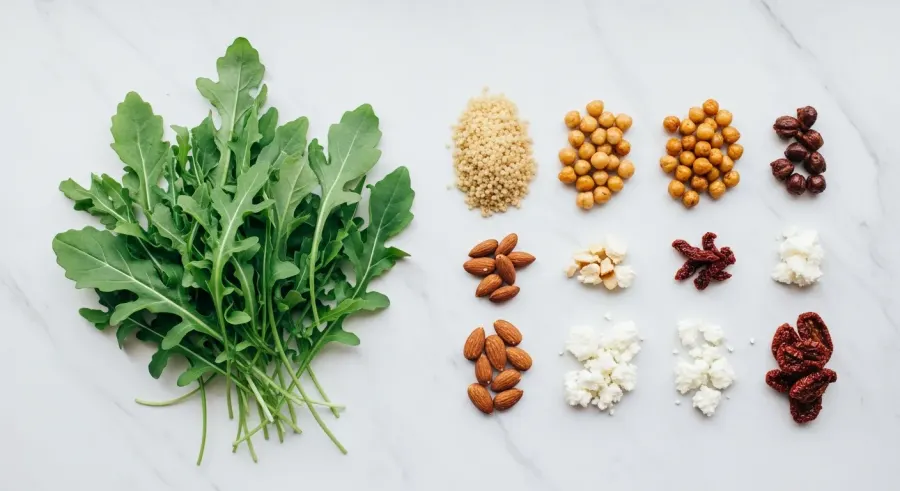
In Short
Watercress offers the closest peppery flavor match to arugula, while baby spinach is the best replacement if you only need a soft, mild texture. The exact ratios for these swaps (and the science behind why dandelion greens might ruin a delicate vinaigrette) are below.
You open the fridge to make a salad, and the arugula is gone. Maybe it wilted into a tragic green puddle, or maybe someone ate the last handful. Whatever the case, finding a substitute for arugula in salad requires knowing exactly what job those leaves were doing in your bowl. A recipe usually calls for arugula either to provide a spicy, mustard-like kick, or simply to serve as a soft, fast-wilting base. Figuring out which trait you need to replace changes everything about the swap.
Watercress for the Peppery Bite
Watercress shares a botanical family tree with arugula, making it the most accurate flavor swap for your salad bowl. The signature peppery bite in arugula comes from a glucosinolate compound called erucin (Journal of Agricultural and Food Chemistry, 2016). Watercress relies on a nearly identical defense mechanism, utilizing a compound called phenethyl isothiocyanate (PEITC) to trigger those same heat receptors on your tongue. Because they share this chemical strategy, replacing one with the other maintains the exact flavor profile your recipe intended.
You can use one cup of watercress for every one cup of arugula. Visually, the leaves are smaller and rounder, but they take up about the same amount of physical space. When it comes to the nutritional breakdown, watercress is noticeably lighter. A 100-gram serving of arugula contains 25 calories and 3.65 grams of carbohydrates. The same amount of watercress drops to just 11 calories and 1.29 grams of carbohydrates, while maintaining nearly identical protein levels at 2.3 grams (USDA).
This is the ideal substitute for vinaigrette-heavy salads and anywhere you need a sharp mustard-like punch to cut through rich ingredients. The small, rounded leaves of watercress have a slightly more delicate cell structure than mature arugula, which helps them trap droplets of oil exceptionally well to create a cohesive bite.
There is a specific situation where watercress fails as a substitute. The hollow stems of watercress hold significantly more moisture than the flat stems of arugula. If you dress a watercress salad and let it sit for too long, that internal moisture begins to leach out. This waters down delicate oil-based dressings and turns the bottom of your salad bowl into a murky puddle. Watercress requires dressing at the absolute last second.
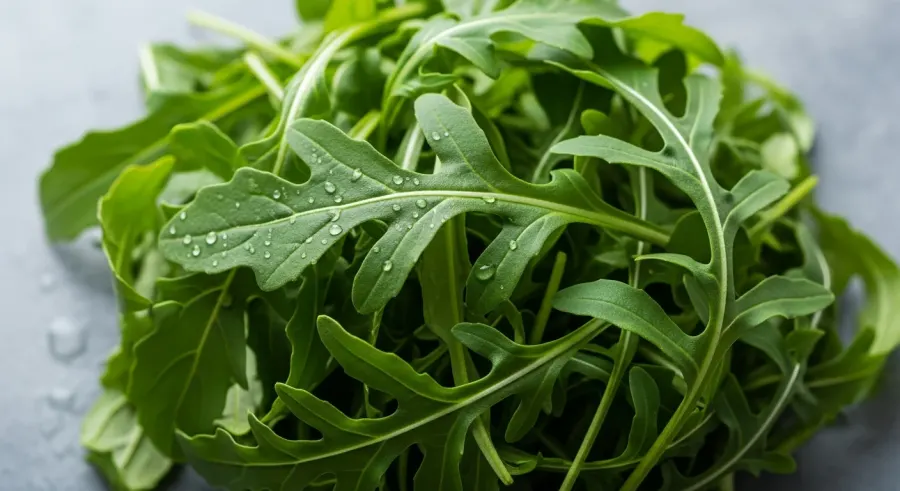
Baby Spinach for a Mild Base
Some people actually prefer their salads without the harsh, bitter edge that arugula brings. If you are serving a crowd or simply dislike that peppery heat, baby spinach is your safest alternative. It completely lacks the glucosinolates that give mustard greens their spice, offering a mild, slightly sweet earthiness instead. The texture of baby spinach is almost a perfect match for baby arugula—pliable, soft, and easy to chew.
You can use a 1:1 replacement by volume. Because the leaves are flat and broad, they will toss in the dressing identically to arugula. From a macronutrient perspective, the two greens are remarkably close. Spinach provides 23 calories per 100 grams, with 2.86 grams of protein and 0.39 grams of fat. It does offer a slightly higher fiber content at 2.2 grams compared to arugula's 1.6 grams (USDA).
Spinach thrives in bulk salads with sweet dressings, fruit-heavy salads featuring strawberries or sliced apples, or situations where you are feeding picky eaters. It operates as a blank canvas, absorbing whatever flavors you introduce rather than competing with them.
Spinach becomes a liability if your recipe relies on the greens to balance out heavy, fatty ingredients. In a salad loaded with cured meats, blue cheese, or heavy mayonnaise-based dressings, the mild flavor of spinach simply disappears. Arugula usually acts as a sharp knife cutting through that richness. Without that peppery counterbalance, a heavy salad can quickly become cloying and one-dimensional. Spinach also wilts entirely differently under heat, collapsing instantly if tossed with a warm bacon vinaigrette.
Radicchio for Serious Crunch
What if the arugula was chosen specifically for its bitterness rather than its heat? When that happens, radicchio steps in to deliver a much more robust, structural bitterness. The chemical driver here is completely different from the peppery greens. Instead of sulfur-based compounds, radicchio gets its astringency from lactucopicrin, an entirely different bitter principle.
Because the flavor is so concentrated, you will want to use about three-quarters of a cup of chopped radicchio for every cup of arugula. The texture is a dramatic departure from soft leafy greens. Radicchio has tight, cabbage-like leaves that snap and crunch when you bite into them. Nutritionally, 100 grams of raw radicchio provides 23 calories, 1.43 grams of protein, and 4.48 grams of carbohydrates (USDA). It is also virtually fat-free at 0.25 grams.
This is the green you want when working with warm, heavy ingredients. Toss radicchio with roasted root vegetables, warm bacon vinaigrettes, or heavy cream-based dressings. The thick cell walls of the leaves will not wilt under heat or heavy fats, maintaining their crunch long after arugula would have surrendered and turned mushy. The striking wine-red leaves with stark white veins also bring significant visual contrast to a bowl.
Radicchio struggles in delicate, simple side salads where it serves as the only green. The bitterness is too aggressive to stand alone with just a squeeze of lemon and a drizzle of olive oil. If you substitute it in a raw, minimalist salad, the astringent finish dominates every other flavor on the plate.
Mizuna as the Textural Match
You might have to look slightly harder to find mizuna in a standard grocery store, but the effort pays off. As a Japanese mustard green, it shares a very similar genetic background with arugula. The leaves have jagged, feathery edges that look striking on a plate, mimicking the visual appeal of wild arugula perfectly. (It requires immediate washing and should be stored wrapped in a dry paper towel to prevent the fragile leaves from spoiling).
The substitution ratio is one to one by volume. Flavor-wise, mizuna delivers a clear, recognizable mustard heat, but it is noticeably milder and sweeter than mature arugula. It does not possess the same earthy, sometimes pungent finish, making it a highly agreeable middle ground between the blandness of spinach and the aggression of arugula. It is lightweight and airy, meaning a cup of mizuna feels less dense than a cup of tightly packed spinach.
Mizuna shines in mixed green salads, light citrus vinaigrettes, and delicate presentations where the shape of the leaf is part of the dish's appeal. It is particularly effective in Asian-inspired salads featuring sesame oil, rice vinegar, and soy sauce, as its natural mustard notes harmonize beautifully with those ingredients.
The primary drawback of mizuna is its structural fragility. The stems are very thin, and the feathery leaves lack a protective waxy coating. Mizuna wilts even faster than arugula under the weight of hot ingredients. Using it as a bed for freshly grilled chicken or hot roasted potatoes results in a stringy, unappetizing texture at the bottom of the bowl.
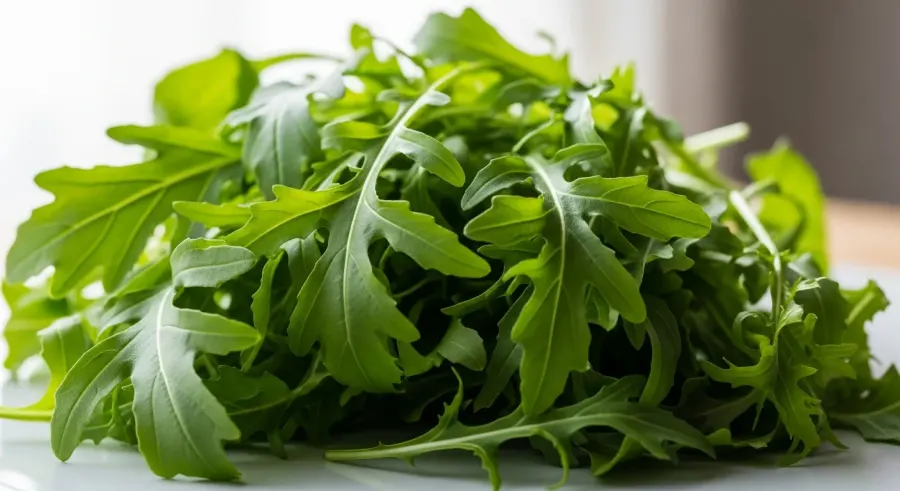
Dandelion Greens for High Intensity
This option requires a bit of culinary courage. Dandelion greens take the sharp, earthy notes of arugula and amplify them to their absolute maximum. They are highly bitter with an earthy, almost medicinal finish that demands attention in a salad bowl.
Because of this intensity, a direct swap usually backfires. Use half a cup of chopped dandelion greens for every one cup of arugula, and pad the rest of the volume with a neutral green like butter lettuce or romaine. Dandelion greens are structurally hardy, with thick, fibrous stems and deep green, jagged leaves. They require aggressive chewing and hold up to rough handling in the kitchen.
Hearty winter salads are the ideal environment for dandelion greens. They need strong companions to balance their flavor profile. Pair them with ingredients that offer intense sweetness or heavy fat. Sliced pears, dried figs, candied pecans, and rich blue cheese all work well to domesticate the bitterness. The bitter compounds actually amplify the perception of sourness on the palate, so whisking a teaspoon of maple syrup or honey into your vinaigrette helps bridge the gap between the earthy greens and the dressing.
Serving raw dandelion greens to people expecting a standard, mild side salad usually ruins the meal. The bitterness easily overwhelms a light lunch. Additionally, older, larger dandelion leaves can be very tough. If you are forced to use mature leaves instead of baby greens, slicing them into very thin ribbons (a chiffonade) is practically required to make them pleasant to eat raw.
Frisée for Volume and Texture
Classic French bistro salads often rely on this pale, frizzy green to create towering, voluminous presentations. Frisée, which is a type of curly endive, works exceptionally well as an arugula substitute when your primary goal is texture and plate coverage rather than spicy flavor.
You have to adjust your measurements when making this swap. Use one and a half cups of frisée for every cup of arugula. The curly, branching structure of the leaves means it takes up significantly more empty space in a measuring cup. Flavor-wise, it offers a mild, grassy bitterness, completely lacking the peppery bite of mustard-family greens. The stems provide a satisfying, watery crunch that contrasts nicely with the softer, frizzy ends of the leaves.
Frisée excels in salads that include a poached egg, warm bacon, or thick, emulsified dressings. The intricate, curly leaves act like a net, trapping small bits of dressing, cheese, and toppings so that every bite is evenly coated. A single head of frisée offers a gradient of textures. The dark green outer leaves are tough and noticeably bitter, while the pale yellow core is tender and mildly sweet. For a delicate salad, tearing away the outer greens and using only the yellow center yields the best results.
This structure becomes a liability in tightly packed or dense salads. If you are trying to make a compact layered salad in a jar, or if you need the greens to lay flat underneath a piece of fish, frisée fights you the entire time. It simply refuses to compress gracefully.
Belgian Endive for a Bitter Snap
Sometimes the greens are just a vehicle for heavy toppings. When the structural integrity of the leaf is paramount, Belgian endive is the most reliable substitute you can pull from the crisper drawer.
Endive is best measured by the leaf rather than the cup. About four to five large endive leaves will replace the volume of a cup of arugula. The flavor profile is characterized by a clean, bright bitterness that snaps the palate to attention. Unlike the broad, flat leaves of arugula, endive grows in tight, torpedo-shaped heads. The leaves are rigid, scooped like little boats, and heavily ribbed with water-dense veins.
This rigid structure dictates how you use it. Endive is unmatched in composed salads where you want to arrange ingredients precisely on the plate. The leaves can actually be filled with other salad components—like a mixture of apples, walnuts, and dressing—allowing the diner to pick them up and eat them by hand. It also pairs flawlessly with sweet citrus fruits like grapefruit and orange, which temper its bitter edge. Endive pieces can sit in a pool of dressing for an extended period without losing their structural integrity, making it an excellent choice for buffet tables where a salad might sit out for a while.
Tossing whole Belgian endive leaves into a mixed salad exactly as they come off the head makes the dish difficult to eat. Even if you chop the leaves horizontally into rigid, crescent-shaped pieces, they will never mimic the soft, pliable mouthfeel of baby arugula.
Bottom Line
Replacing an ingredient is rarely about finding an exact clone. It is about understanding the mechanics of your recipe. If the arugula was there to provide a sharp, peppery contrast to sweet fruits, watercress will carry that torch without missing a beat. If it was just providing a splash of green under a piece of fish, spinach does the job perfectly. Understanding those mechanical roles is usually all it takes to keep a missing ingredient from derailing a meal.