In Short
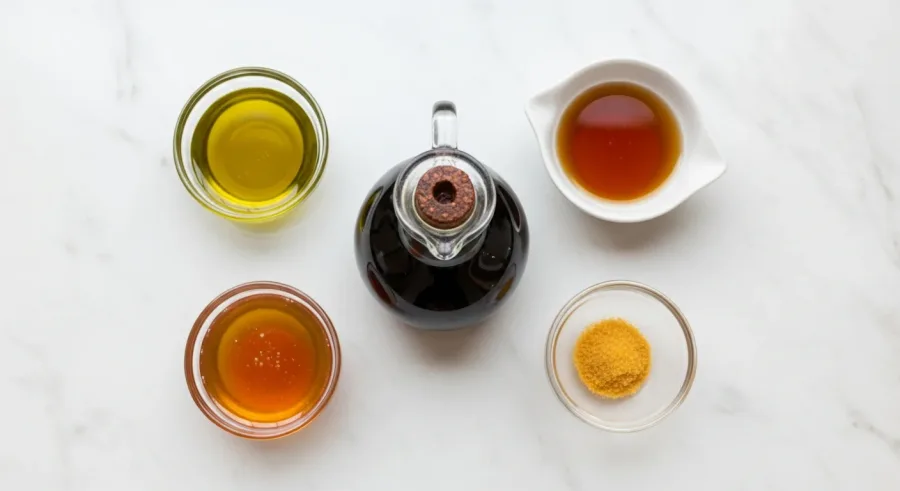
The closest everyday match for balsamic vinegar is mixing 1 tablespoon of red wine vinegar with ½ teaspoon of maple syrup. If you are making a glaze or a marinade, you will need to use different pantry staples to replicate the thick texture.
Balsamic vinegar has a very specific job in the kitchen. It brings a dark, heavy sweetness and a mellow acidity that regular vinegars just can't manage on their own. When your bottle runs dry right before dinner, fixing the problem means mixing a few pantry staples together to recreate that exact balance of tart, sweet, and sticky.
The Red Wine Vinegar Trick
Most of the time, the easiest answer is sitting right next to the empty space on your pantry shelf. Red wine vinegar and balsamic are fundamentally related. Both begin with grapes. The difference is that balsamic is made from unfermented grape must that gets reduced and aged in wooden barrels, while red wine vinegar is just fermented wine.
The main thing separating them is residual sugar. A standard tablespoon of balsamic contains roughly 2.4 grams of sugar (USDA). Red wine vinegar has basically zero.
To bridge this gap, mix 1 tablespoon of red wine vinegar with ½ teaspoon of maple syrup. The maple syrup dissolves immediately without needing any heat. It also provides a faint, woody caramel note that mimics the barrel-aging process much better than plain white sugar. When you buy standard balsamic at the grocery store, you are usually buying 'Balsamic Vinegar of Modena.' This is a commercial product made by blending grape must with red wine vinegar to speed up production. So, when you mix red wine vinegar with a sweetener at home, you are quite literally reconstructing the commercial process.
If you are tracking your meals, this combination keeps the macronutrients almost identical. Balsamic has 14 calories per tablespoon and zero fat (USDA). Red wine vinegar has about 3 calories, but the added maple syrup bumps the total right back up to match the original.
This is your best all-purpose option. It works perfectly in a standard vinaigrette, or tossed with roasted vegetables right before serving. The only time this falls apart is if you try to reduce it in a pan. Boiling maple syrup and thin vinegar just leaves you with a sticky, separated mess rather than a cohesive glaze.
When You Only Have Apple Cider Vinegar
Apple cider vinegar has a completely different backbone. Instead of the tartaric acid found in grapes, it relies on malic acid (the specific compound that gives green apples their bite). It tastes sharper, fruitier, and decidedly less Italian.
You can still use it as a base. The trick is masking that bright apple flavor with a heavy, dark sweetener.
Mix 1 tablespoon of apple cider vinegar with ½ teaspoon of dark brown sugar. You will need to stir this vigorously to get the sugar crystals to dissolve. You can also pop it in the microwave for five seconds to speed up the process. The molasses hiding inside the dark brown sugar is doing all the heavy lifting here. It darkens the liquid and rounds out the sharp edges of the apple cider vinegar.
Both vinegars are highly acidic, meaning the acidic bite is chemically similar once the sugar is integrated. Because apple cider vinegar is often unpasteurized and contains a cloudy web of beneficial bacteria, it brings a slight funkiness that traditional balsamic lacks. This makes it an excellent pairing for autumn-themed dishes containing squash, pecans, or dried cranberries.
Use this when you are making a marinade for pork or chicken. The meat can easily handle the robust flavor. Avoid using this mixture to deglaze a pan for a delicate sauce, because the apple notes will survive the cooking process and overpower everything else on the plate.
The Clear Alternative
If you happen to have white balsamic in your cupboard, you already own a near-perfect match.
White balsamic is made from the exact same Trebbiano grapes as the traditional dark version. The difference is simply temperature. White balsamic is pressure-cooked at a lower heat to prevent the sugars from caramelizing, and it is not aged in charred wooden barrels.
You can swap this at a simple 1:1 ratio.
It has the identical balance of tartaric acid and residual grape sugar. You get all the mellow, sweet acidity without any of the heavy molasses notes.
This is actually the superior choice for dishes where you do not want a muddy brown tint. It keeps peach salads, pale vinaigrettes, and fresh fish looking bright and clean. It only fails when you rely on the dark color for visual contrast (like drizzling over a Caprese salad) or when a heavy meat dish specifically needs the deep, woody flavors of a traditional dark balsamic.
A Swap for Savory Dishes
Sherry vinegar is the sophisticated cousin in the vinegar world. Like true balsamic, it spends a long time aging in oak barrels. That shared process gives it a woody, nutty profile that raw distilled vinegars completely lack. True sherry vinegar is protected by Spanish law and aged in a solera system. This exposes the liquid to controlled amounts of oxygen over time, similar to how balsamic ages in open-topped wooden barrels.
The catch is the acidity level. Sherry vinegar is sharp. It typically hovers around 7% acetic acid, which makes it noticeably more aggressive than a mellow balsamic.
To balance that bite, combine 1 tablespoon of sherry vinegar with ½ teaspoon of honey. Honey is thicker than maple syrup, so it adds a tiny bit of much-needed viscosity to the mix.
The controlled oxidation that sherry vinegar undergoes makes it taste rounded and complex. This combination is excellent for making pan sauces after searing a steak, or for dressing a simple tomato salad. It falls short when you need a thick, clingy glaze. Sherry vinegar is exceptionally thin. Adding enough honey to thicken it will just make your food taste like a dessert.
The Umami Wildcard
If you keep Chinese black vinegar (specifically Chinkiang vinegar) in your kitchen, you already own a brilliant structural match.
Both condiments are dark, complex, and rely on a long aging process to develop their flavor. But where balsamic gets its sweetness from grapes, black vinegar is fermented from glutinous rice, wheat, or sorghum. The deep color comes from the Maillard reaction happening over months in clay pots. It tastes malty, slightly smoky, and far less acidic than standard white vinegar.
You can swap this at a 1:1 ratio. Since it lacks the syrupy sweetness of an aged Italian balsamic, whisk in a small pinch of granulated sugar.
This swap shines in savory, high-heat cooking. Drizzle it into stir-fries, brush it on roasted mushrooms, or use it in slow braises. Just keep it far away from dessert. A traditional balsamic is beautiful poured over fresh strawberries or vanilla ice cream. Black vinegar on fruit is an experience you will likely regret.
Faking It With Soy Sauce
Sometimes a recipe just needs that dark, salty-sour-sweet profile to anchor a marinade. When you are totally out of vinegar, you can build a highly functional replica using condiments that seem completely unrelated.
Mix 1 tablespoon of soy sauce, 1 tablespoon of fresh lemon juice, and ½ teaspoon of molasses.
The lemon juice provides the necessary citric acid. The soy sauce brings umami and a dark, opaque color. The molasses ties it together with a bittersweet depth. Marinades rely heavily on sugar to create a crust on grilled meats. The molasses in this mixture provides that exact caramelization, while the soy sauce tenderizes the proteins.
You must adjust your seasoning if you use this trick. A tablespoon of balsamic has barely 4 milligrams of sodium, while a standard tablespoon of soy sauce contains nearly 900 milligrams (USDA). You need to completely eliminate any other added salt in your recipe.
This is strictly for savory applications. It works beautifully on grilled vegetables or tofu. It is a terrible idea for salad dressing. Mixing soy sauce and lemon juice with olive oil creates a muddy, confusing vinaigrette that just tastes salty.
Building That Syrupy Texture
Texture is usually the first casualty when you swap out balsamic. True aged balsamic has a thick, velvety weight to it because water evaporates through the wooden barrels over the years. Thin vinegars just run straight to the bottom of the bowl.
Pomegranate molasses is essentially reduced, concentrated pomegranate juice. It shares the same tart, tannic qualities as grape must, along with the same long-chain carbohydrates that create that thick texture.
Whisk 1 tablespoon of pomegranate molasses with ½ tablespoon of plain white vinegar or rice vinegar. The pomegranate provides the dark color, the heavy viscosity, and the sweetness. The plain vinegar just thins it out slightly and bumps up the acidity.
Use this when presentation matters. If you are making a fresh tomato salad and want those dark, glossy streaks across the cheese, this is the only substitute that looks right. It does not work well in light dressings, as the heavy syrup tends to clump up rather than emulsifying smoothly.
The Grape Jelly Hack
This sounds like a trick from a 1950s cookbook. It actually works surprisingly well.
Balsamic is fundamentally just grapes and time. Grape jelly is just concord grapes and sugar boiled down until thick. When you combine the jelly with a harsh vinegar, they meet somewhere in the middle.
Mash 1 teaspoon of grape jelly with 1 tablespoon of red wine vinegar. Add a single drop of soy sauce for savory depth. You have to whisk this aggressively (a fork works best) to break up the gelatinous clumps.
The flavor is highly accurate. It carries a distinct, fruity sweetness that plain sugar or honey cannot replicate. Use this when a recipe calls for a small amount of balsamic to finish a soup or a stew. Skip it if you are making a raw salad. Tiny unincorporated clumps of jelly will inevitably hide in the lettuce leaves, which throws off the texture of the whole dish.
Bottom Line
Finding a replacement for balsamic vinegar usually just comes down to knowing what role it was supposed to play in your recipe. If you need the acidity for a vinaigrette, simple pantry staples can easily bridge the gap. If you need the dark, glossy texture for a finishing drizzle, leaning on heavier ingredients like molasses or fruit preserves will get you much closer to the real thing.