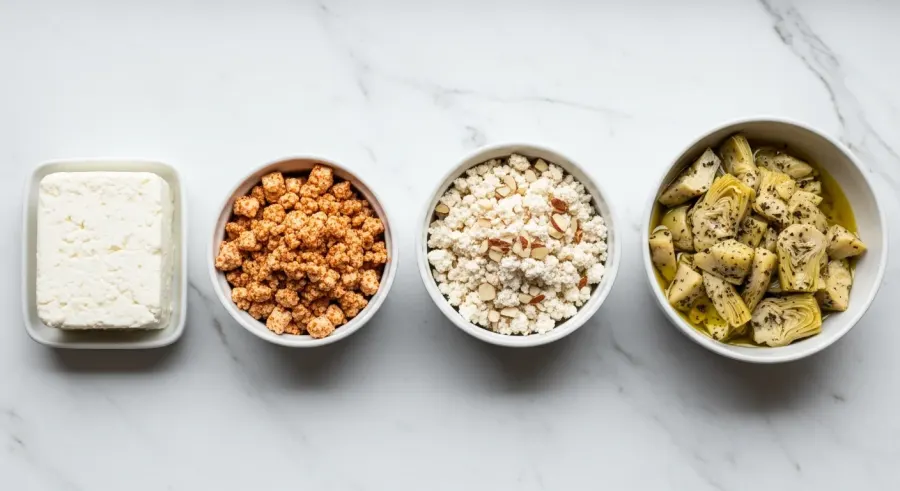
In Short
Cotija is your closest overall match for salt and crumble, while soft goat cheese brings the exact same tangy acidity. The right substitute for feta cheese depends entirely on whether you need it to melt, hold its shape in a salad, or provide a low-sodium swap—the breakdown of how to handle each situation is below.
You reached for the feta, and the container is empty. It happens. Feta brings a very specific sharp, salty, crumbly energy to a dish, which means finding a replacement isn't just about picking another white cheese out of the fridge. You have to know what job the cheese is actually doing. Are you tossing it into a cold salad where it needs to hold its shape? Melting it into a warm pasta? Looking for a dairy-free swap that genuinely works? We can fix this.
Cotija Is Your Closest Overall Match
This aged Mexican cow's milk cheese is often called the Parmesan of Mexico, but its crumbly texture and punchy salt level make it the ultimate feta stand-in. It breaks apart into those familiar, satisfying nuggets that scatter perfectly over a dish.
If you are topping a salad, finishing a grain bowl, or rolling roasted corn, use exactly the same amount of cotija as you would feta (a simple 1:1 ratio). The primary flavor difference is the acidity. Feta brings a lemony brightness anchored by a wet brine, while cotija leans into a deeper, funkier savory profile cured with dry salt.
Cotija is on the drier side. When you toss it into a heavily dressed salad, it won't bleed a milky residue into your vinaigrette the way a creamy feta does. It holds its structural integrity beautifully.
Do not try to bake it into a spanakopita or melt it into a hot dip. Cotija simply doesn't melt smoothly. Under high heat, it tends to sweat out its fat and get rubbery.
Nutrition-wise, it is a slightly richer choice. While standard feta sits at 265 calories and 21.5 grams of fat per 100 grams, cotija hovers around 366 calories with roughly 30 grams of fat (USDA FoodData Central). You get a bit more richness, so you might find you naturally want to use slightly less oil in your dressings to balance the plate.
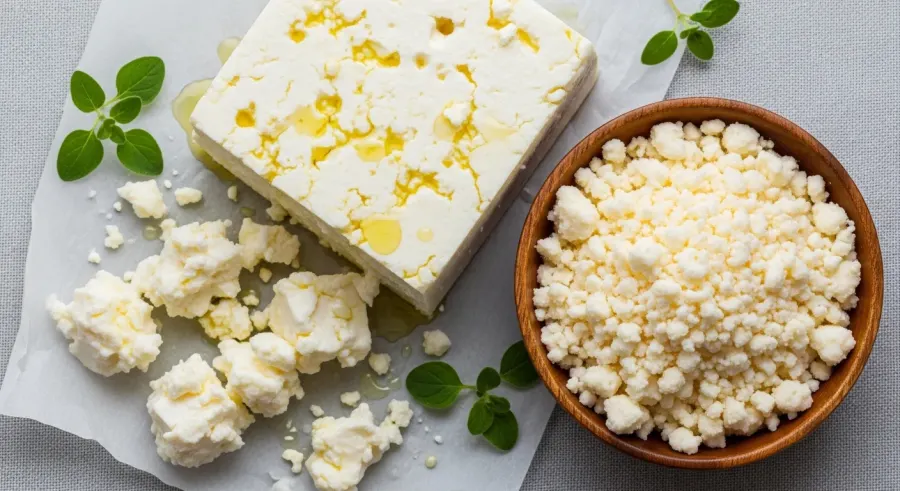
Goat Cheese Hits the Exact Same Tang
If your recipe desperately needs the sharp, lactic bite that feta provides, fresh goat cheese (chèvre) is exactly what you want. It shares that bright, acidic profile that cuts through heavy dressings and rich olive oils beautifully.
You can swap it one-to-one, but you have to account for the massive textural shift. Goat cheese has a much higher moisture content and a lower melting point. It is significantly creamier and stickier than feta. This makes it a brilliant choice for spreading on warm toast, whisking into a hot pasta dish where it will melt into a luxurious sauce, or dropping into tomato soup. If you want it to stay in clumps over a salad, chill the goat cheese in the freezer for ten minutes before crumbling it.
It fails completely in highly watery environments like a fresh watermelon salad. The moisture from the fruit turns goat cheese into an unappealing white paste instead of holding its shape the way feta would.
Soft goat cheese provides 264 calories, 18.5 grams of protein, and 21.1 grams of fat per 100 grams (USDA FoodData Central). The macronutrients are nearly identical to feta, but that sticky moisture level completely changes how it behaves in a mixing bowl.
Ricotta Salata Was Made for Summer Salads
This is not the wet, spoonable ricotta you put in a baked lasagna. Ricotta salata is ricotta that has been pressed, salted, and aged into a firm wheel. It holds its shape beautifully and grates into delicate, snowy piles.
Because it lacks the brine-soaked sharpness of feta, the flavor is much milder, sweeter, and cleaner. It is the elegant Italian answer when you want a cheese to compliment a dish rather than dominate it. Use a 1:1 ratio by volume. Shave it over cold pasta salads, grilled peaches, or heavily dressed greens.
Because it has a somewhat spongy interior, it absorbs olive oil and vinaigrettes heavily. If you use it in a salad, you might want to dress the greens right before serving so the cheese doesn't get soggy.
Skip this option if you need a structural cheese for a savory pastry filling. It simply gets lost in heavy doughs and doesn't provide enough salt to carry a dish on its own.
Packing around 250 calories, 14 grams of protein, and 18 grams of fat per 100 grams (USDA FoodData Central), it is comparable in richness to feta. A small amount shaved with a vegetable peeler provides a lot of visual coverage on a plate.
Queso Fresco Gives You Milder Crumbles
Sometimes you want the visual appeal and bouncy texture of feta, but you really want to dial back the intense sodium. Queso fresco is a fresh, unaged Mexican cheese that looks almost identical to feta when crumbled over a plate, though the crumbles tend to be smaller and finer.
The flavor is exceptionally mild. It tastes mostly of fresh milk with barely any salt. It is fantastic when you need to cool down a spicy dish, like a heavy chili, a spicy green salad, or black bean enchiladas. You can use it in a 1:1 ratio without overwhelming the other ingredients.
It will, however, ruin a traditional Greek salad. Without feta's aggressive brine, a simple mix of tomatoes, cucumbers, and olive oil just falls flat. If you make this swap, you have to manually add the acid and salt back to the dish. Add an extra squeeze of lemon or a dash of red wine vinegar to your vinaigrette, and hit the vegetables with a heavy pinch of kosher salt to compensate for the mild cheese.
At 299 calories and 18.1 grams of protein per 100 grams (USDA FoodData Central), it brings solid protein. You just have to be willing to adjust your seasoning elsewhere.
Grab Halloumi When You Need to Use Heat
If you loved the idea of a warm baked feta dish but want something that can actually take direct heat, halloumi is unmatched. This semi-hard Cypriot cheese has an unusually high melting point. The curd is actually heated in its own whey before being shaped, which denatures the proteins and prevents them from melting later. You can literally throw it on a hot grill.
The flavor is very salty and slightly squeaky on the teeth, but it completely lacks feta's crumbly nature. When seared in a dry pan, it tastes like toasted milk with a savory, caramelized crust. It is perfect for pan-frying or roasting alongside cherry tomatoes. Slice it thick instead of trying to crumble it.
Never use raw halloumi as a feta substitute. Uncooked, it is rubbery, bland, and genuinely unpleasant in a cold salad. You must cook it to wake up the texture and flavor.
This is a heavy hitter nutritionally. Halloumi runs about 393 calories and packs roughly 32 grams of fat per 100 grams depending on the brand (USDA FoodData Central). That extra fat is exactly why it fries up to a perfect golden brown without sticking to the pan.
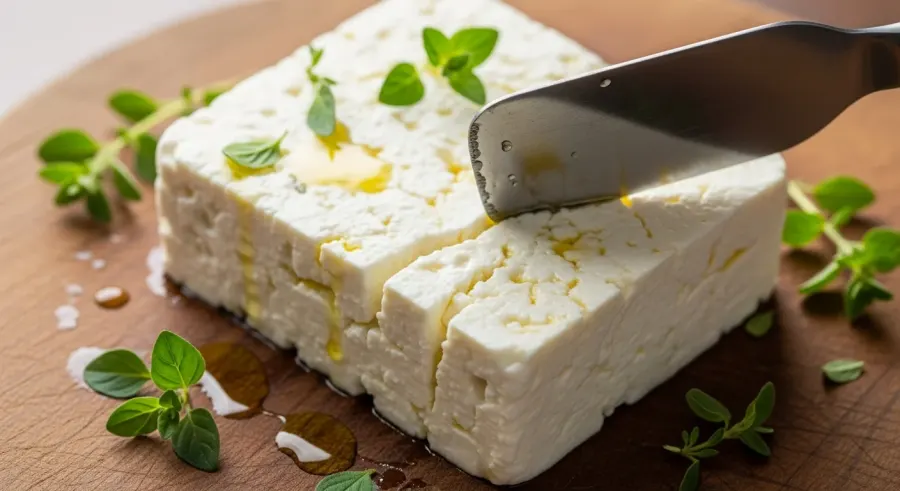
How to Make Firm Tofu Actually Work
Swapping dairy for a plant-based alternative is entirely possible, but you have to do the work. Straight from the package, tofu tastes like absolutely nothing.
To create a vegan feta substitute, you need extra-firm tofu that has been pressed for at least thirty minutes to remove excess water. This pressing creates microscopic pockets in the protein matrix that will absorb flavor. Cube the pressed tofu, then soak it in a marinade. A good baseline is two tablespoons of olive oil, one tablespoon of nutritional yeast, a tablespoon of lemon juice, a splash of apple cider vinegar, and a teaspoon of salt for every block of tofu.
Give it at least two hours (overnight is better). Once marinated, it mimics the exact texture and visual weight of feta. It is excellent tossed into cold salads, wrapped in pita bread, or scattered over a vegan pizza after baking.
Do not attempt to melt or bake this expecting a creamy result. It will simply dry out and turn leathery in the oven.
This swap drastically changes the nutrition profile. Firm tofu drops you down to just 144 calories and 8.7 grams of fat per 100 grams, while still delivering 17.3 grams of complete protein (USDA FoodData Central).
Blue Cheese Delivers an Aggressive Flavor Punch
Sometimes you just need a cheese that refuses to be ignored. Blue cheese—whether you grab a Roquefort, Gorgonzola, or a crumbly Danish blue—shares feta's intense saltiness and crumbly nature, but turns the funk dial up to a ten.
Because the flavor is so sharp, earthy, and pungent, you should only use about half the amount the recipe calls for. It is spectacular crumbled over a wedge salad, folded into a steak sandwich, or sprinkled over roasted root vegetables. Roquefort is made from sheep's milk (just like traditional feta) so it shares a similar barnyard tang, whereas Gorgonzola is cow's milk and tends to be slightly sweeter.
Do not use blue cheese in light, delicate dishes like a watermelon mint salad or a simple cucumber toss. The bold moldy notes will completely overpower the fresh ingredients. It also coats the mouth much more than feta does. You must balance it with sharp acids like apple cider vinegar or lemon juice to cut the fat.
It is significantly richer. Blue cheese packs 353 calories, 21.4 grams of protein, and a hefty 28.7 grams of fat per 100 grams (USDA FoodData Central).
Cottage Cheese Steps In for Creamy Dips
This might sound like a massive stretch, but if you are making whipped feta, a creamy pasta sauce, or a spreadable dip, cottage cheese is a brilliant secret weapon.
To make it work, you have to run it through a food processor or blender until the curds are completely smooth. Add a squeeze of lemon juice, a heavy pinch of salt, and a splash of white vinegar to mimic feta's signature fermented tang. Once blended, it works beautifully as a high-protein spread on toast or a creamy base for roasted vegetables.
Obviously, this fails completely if you need a structural, crumbly cheese for a salad or a tart. Cottage cheese is swimming in whey. If you try to bake it into a spanakopita, the water will turn the phyllo dough into a soggy disaster. It is strictly a textural stand-in for wet, blended applications.
The benefit here is a massive drop in calories. A standard 2% low-fat cottage cheese is only 98 calories and 4.3 grams of fat per 100 grams, while still offering 11.1 grams of protein (USDA FoodData Central). It allows you to create rich, creamy dips without the heavy caloric load.
Bottom Line
Feta has a very specific job in the kitchen—it provides salt, acid, and a crumbly texture all at once. The trick to replacing it isn't finding a perfect clone, but deciding which of those three elements your dish needs most. A heavy salad might just need the dry salt of cotija, while a warm pasta might be crying out for the creamy tang of goat cheese. You just have to trust your palate and adjust your seasoning as you go.