I’ll bet my favorite cast-iron skillet you have a tiny, absurdly expensive brown glass bottle sitting in your baking cabinet right now. You drop a teaspoon of it into pancake batter, swirl it into holiday cookies, and never once stop to ask what exactly you’re pouring. But if you suddenly find yourself needing to bake a strictly plant-based birthday cake for a friend, that little bottle becomes a massive liability. The internet will tell you it's squeezed from the backside of a beaver. Your grandmother will tell you it's just pure plant magic. They are both spectacularly wrong.
The Beaver Butt Myth Just Won't Die
Let’s aggressively kill the internet’s favorite food rumor right out of the gate. For the last decade, panic-inducing articles have claimed that vanilla flavoring comes from castoreum—a chemical compound secreted by the anal glands of the North American beaver. Gross? Incredibly. True? Absolutely not.
Here is why this myth caught fire: castoreum actually does exist, and historically, perfumers and early flavor scientists discovered its musky, slightly sweet aroma mirrored the complexity of real vanilla. The FDA even classifies it under the deliberately vague umbrella of "natural flavorings." But let's look at the brutal economics. Extracting castoreum requires manually milking the anal glands of live, anesthetized beavers. As a result, the annual US consumption of castoreum in the flavor industry sits at a microscopic 300 pounds (Fenaroli’s Handbook of Flavor Ingredients, 6th Edition, 2009).
Compare that to the 40 million pounds of vanilla flavoring consumed globally every year. Nobody is sneaking a $70-per-ounce, labor-intensive beaver secretion into your $4 bottle of generic supermarket baking aisle flavor. The math physically prevents it. If you are asking 'is vanilla extract vegan' simply because you're terrified of forest rodents, you can breathe a sigh of relief. But your vegan troubles are far from over.
The 35% Rule and the Invisible Animal Bones
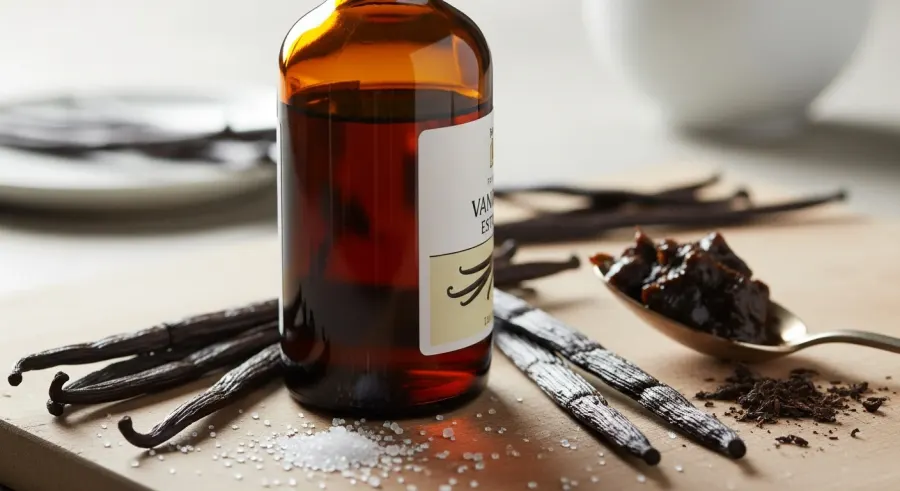
If you flip over a bottle of pure vanilla extract, you'll see a painfully short ingredient list: Vanilla bean extractives, water, alcohol, and sugar. It looks like a plant-based dream. But the hidden failure point lies in the government's strict legal definitions.
To legally call a product "pure vanilla extract" in the United States, the FDA dictates it must contain no less than 35% ethyl alcohol by volume, and extract from 13.35 ounces of vanilla beans per gallon (FDA 21 CFR 169.175). What the FDA doesn't regulate is where that alcohol or the added sugar comes from.
Let's look at the official USDA FoodData Central statistics for standard vanilla extract: 288 calories, 0.06g of protein, 0.01g of saturated fat, and exactly 12.65g of carbohydrates per 100g. Every single gram of that carbohydrate is raw sugar. To mask the harsh, medicinal bite of the 35% alcohol, manufacturers dump cane sugar into the vats.
Here is why that destroys its plant-based status: conventional cane sugar in North America is routinely processed and decolorized using bone char. Bone char is exactly what it sounds like—the heavily charred pelvic and femur bones of slaughtered cattle. The bones act as a carbon filter to turn raw, brownish sugar into the sparkling white crystals that eventually melt into your vanilla bottle. If a manufacturer buys cheap, conventional cane sugar and standard alcohol (which can sometimes be filtered through similar non-vegan clarifying agents), your seemingly innocent bean water is quietly carrying animal agriculture byproducts. This is why I always warn strict vegan bakers: unless the bottle specifically boasts an organic certification (which legally bans bone-char sugar) or a certified vegan logo, you are gambling.
The 12-Year-Old Who Saved Vanilla From Extinction
To understand why real vanilla costs more than a decent bottle of bourbon, you have to look at the violent, frustrating biology of the Vanilla planifolia orchid.
Native to Mexico, this specific orchid was originally pollinated by only one creature on earth: the Melipona bee. When European colonizers stole the vanilla vines and tried to plant them in Madagascar and Indonesia in the 1800s, the vines grew beautifully, but they never produced a single pod. The bees didn't exist outside of Mexico, and the flowers simply dropped dead. The global vanilla trade was essentially frozen.
That changed in 1841 on the island of Réunion. A 12-year-old enslaved boy named Edmond Albius figured out something the greatest European botanists couldn't. He realized that the orchid flower only opens for a punishingly short 24-hour window. Albius invented a technique using a tiny sliver of bamboo to lift the rostellum (the flap separating the male and female organs of the flower) and used his thumb to smear the pollen together.
Think about that the next time you spill a drop on your counter. Every single natural vanilla bean you have ever consumed was individually hand-pollinated by a human being using a tiny wooden stick. Around 600 hand-pollinated blossoms are required to yield just one kilogram of cured beans. The sheer volume of human labor dictates the astronomical price tag.
Baking Your Money Into the Atmosphere
Here is a deeply unpopular opinion I will defend in any kitchen: if you are making chocolate chip cookies, banana bread, or brownies, stop using $30-per-bottle pure vanilla. You are literally evaporating your hard-earned money.
Real vanilla extract is an incredibly delicate chemical cocktail containing over 250 distinct volatile flavor compounds—things like piperonal, p-hydroxybenzoic acid, and vanillic acid (Journal of Food Science, 2008). These delicate compounds give real vanilla its floral, woody, and almost rum-like complexity.
But heat destroys nuance. When you shove a batch of cookies into a 350°F oven for 14 minutes, the vast majority of those 250 delicate compounds evaporate instantly into the air. That incredible smell filling your kitchen? That is the smell of your $30 vanilla escaping the cookie. You end up with a baked good that tastes vaguely sweet, with none of the floral high notes you paid for.
When do you actually use the expensive stuff? Raw or low-heat applications. Put it in panna cotta. Whip it into heavy cream. Stir it into homemade ice cream bases or buttercream frosting. If the temperature stays under 150°F, the volatile compounds survive, and the flavor punches you right in the palate. Put premium vanilla in a boiling caramel sauce, and you've created a sticky failure case.
The Petrochemical Reality of Imitation Vanilla
If you shouldn't use the expensive stuff for baking, what goes into the cookies? Imitation vanilla. And ironically, imitation vanilla is the safest bet for anyone asking if their vanilla extract is vegan.
Imitation vanilla doesn't bother with the 250 complex compounds of the orchid pod. It isolates the single loudest flavor note—a molecule called vanillin—and synthesizes it in a lab. Today, roughly 85% of the world's synthetic vanillin is synthesized from guaiacol, a precursor chemical derived from petrochemicals (Journal of Agricultural and Food Chemistry, 2003). The remaining percentage is largely crafted from lignin, a wood-pulp byproduct sourced from the paper manufacturing industry.
Wood pulp and petroleum sound terrifying, but synthetic vanillin is biologically identical to the primary vanillin molecule found in the orchid. It is undeniably 100% vegan. It requires no animal bones for filtration, no manual labor from exploited workers in Madagascar, and costs about $5 a pound to produce.
I keep a massive, cheap bottle of imitation vanilla right next to my stove. Because synthetic vanillin is a heavier, more stable molecule, it actually survives the intense heat of a 350°F oven far better than pure extract. If you bake a yellow cake with fake vanilla, it will taste exactly like the nostalgic, boxed-mix birthday cakes from your childhood. Sometimes, lab-created wood pulp is exactly what the recipe demands.
Bottom Line
Go to your pantry right now and pull out your bottle of vanilla. Turn it around and look closely at the ingredient list. If you see the word "glycerin" listed instead of alcohol, you hold a completely alcohol-free extract. If you need absolute certainty that no bone-char sugar touched your bake, toss it and buy a bottle explicitly bearing the USDA Organic seal or a certified Vegan trademark.