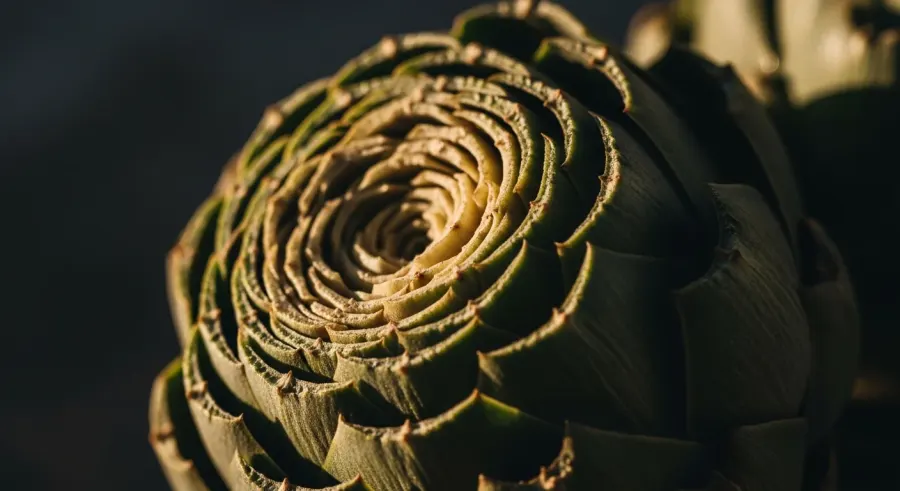
In Short
Artichokes contain a chemical called cynarin that temporarily blocks your tongue's sweet receptors. When you take a sip of water, the cynarin is washed away, and the sudden release of those receptors tricks your brain into perceiving a flood of phantom sweetness.
You finish a bite of steamed artichoke, take a sip of plain tap water, and suddenly pause. The water tastes as though someone stirred a heavy spoonful of refined sugar into your glass. You aren’t imagining things, and your local municipal water supply hasn't been compromised. You have just stumbled into one of the strangest biochemical phenomena in the produce aisle.
The Gustatory Afterimage
Sensory scientists refer to this kind of phenomenon as a release from adaptation, though it is easier to understand as a gustatory afterimage. If you stare at a bright red square on a screen for thirty seconds and then look at a blank white wall, your eyes will temporarily project a green square onto the empty space. Your photoreceptors become fatigued or locked into one state, and when the stimulus is removed, they overcompensate in the opposite direction.
Your tongue operates on a very similar mechanical principle. Human sweet taste is primarily mediated by a specific pair of G-protein coupled receptors known as T1R2 and T1R3, which sit on the surface of your taste buds. Usually, when you eat a piece of fruit or a baked good, sugar molecules bind to these receptors, sending a direct electrical signal to your brain that registers as sweetness.
The artichoke bypasses this normal sequence entirely. It contains a specific compound called cynarin that washes over your tongue and binds directly to those sweet receptors. However, cynarin does not activate them. It simply sits there, blocking the receptor like a broken key jammed into a lock. While the cynarin remains attached, you don't taste anything out of the ordinary. The magic only happens in the physical aftermath.
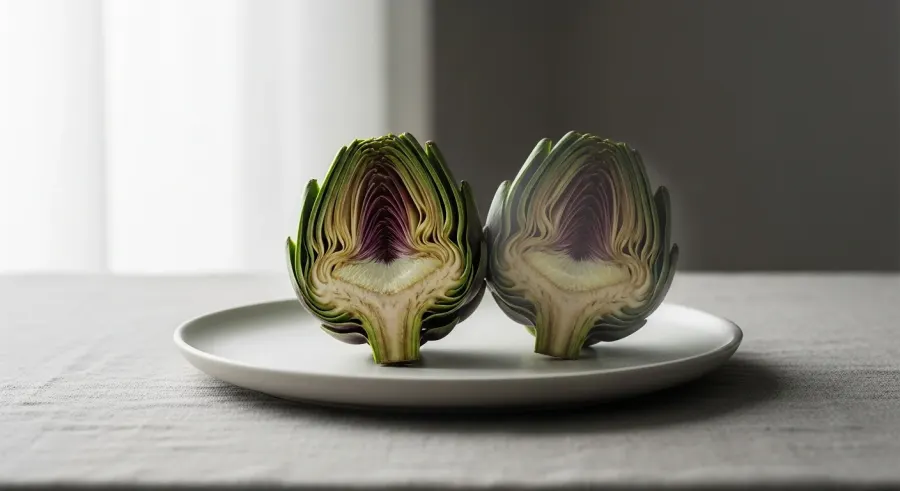
The 1972 Sweet Water Breakthrough
For decades, this phantom sweetness was just a quirky observation shared among chefs, but it eventually caught the attention of serious researchers. In 1972, taste researcher Linda Bartoshuk, alongside colleagues Lee and Scarpellino, published a landmark paper in the journal Science titled "Sweet Taste of Water Induced by Artichoke." They wanted to quantify exactly how powerful this botanical illusion really was.
To measure the effect, the research team isolated the active compounds in the plant. They prepared solutions of cynarin and chlorogenic acid, another phenolic compound found in the vegetable, alongside a raw artichoke extract. Participants were asked to expose their tongues to these liquids, take a drink of plain water, and then compare the perceived sweetness to controlled concentrations of actual sucrose.
The results proved that the effect was intensely physical, not psychological. The artichoke extract produced a sweetness equivalent to a highly concentrated sugar water solution. The sudden introduction of water acts as a neutral solvent. It physically washes the cynarin molecules away from the T1R2 and T1R3 receptors. Your newly liberated taste buds overreact to the abrupt absence of the chemical blockade, sending an aggressive signal to the brain.
You aren't tasting sugar in the water. You are tasting the ghost of the cynarin leaving your tongue. The researchers noted that while pure cynarin and chlorogenic acid both triggered the effect on their own, the raw, complex extract of the vegetable produced the most pronounced phantom sweetness, suggesting the plant's unique chemistry works as a unified system to manipulate the human palate.
The Genetic Lottery of Cynarin
If you have ever tried to demonstrate this party trick to a dinner guest and they stared at you with blank confusion, they aren't gaslighting you. The artichoke sweetness effect is far from universal.
Roughly 60 percent of the population possesses the specific biological traits required to perceive this rebound sweetness. For the other 40 percent, cynarin behaves like a perfectly normal, slightly bitter botanical compound. If they drink water after eating an artichoke leaf, the water just tastes like water.
This sharp divide in human perception baffled culinary professionals for years before the mechanics of taste receptors were mapped. Imagine running a high-end restaurant where slightly more than half of your dining room thinks their expensive mineral water tastes like simple syrup, while the rest of the table has no idea what they are talking about. It is highly reminiscent of the genetic divide over cilantro. While cilantro tastes like dish soap to certain people due to a variation in the OR6A2 olfactory receptor gene, the artichoke divide centers on how securely cynarin binds to your specific sweet receptors, or potentially how the proteins in your individual saliva interact with the compound.
The 1972 Science study documented this exact variance among their test subjects. They found wide discrepancies in how intensely people felt the effect, proving that our taste buds are entirely subjective instruments. We all live in completely isolated sensory worlds, and this particular vegetable simply happens to expose the invisible boundary lines.
The Wine Pairing Psycho Killer
For the better part of a century, classical culinary training labeled artichokes as the "psycho wine killers" of the vegetable kingdom. The rigid rule of fine dining dictated that you simply could not pair wine with an artichoke dish because it would destroy the profile of the vintage.
The logic holds up perfectly once you understand the biology of the sweet receptors. If you take a sip of an expensive, perfectly balanced dry red wine immediately after chewing on an artichoke leaf, the cynarin washes away and the sweet receptors open up. This tricks your brain into perceiving the dry wine as a cheap, sugary fruit punch. The carefully crafted tannin structure falls apart. The wine becomes flabby and entirely unstructured. The cynarin even latches onto the sweet-tasting vanilla and oak notes in a traditional aged Chardonnay, amplifying them until the wine feels unpleasantly syrupy.
Modern sommeliers eventually realized they could weaponize this chemistry rather than run from it. Instead of avoiding the vegetable, you deliberately choose a wine that is severely bone-dry and highly acidic.
A crisp, mineral-heavy Sauvignon Blanc from the Loire Valley or a bone-dry Fino Sherry will normally make your mouth pucker with astringency. But if you eat an artichoke first, the cynarin naturally softens the aggressive acid. The illusion of sweetness balances out the tartness, acting as an invisible dosage of sugar directly on your palate. It transforms the pairing from a ruined experience into an interactive chemistry experiment playing out in real time.
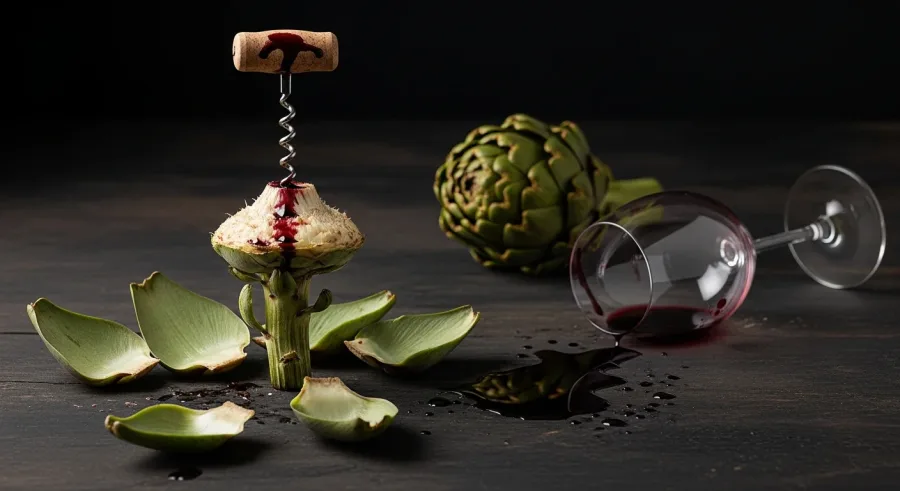
Why Jarred Hearts Ruin the Trick
Before you reach for a jar of marinated artichokes from the pantry to test this biological quirk, you should know that commercial processing fundamentally alters the required chemistry.
The intense pickling environments—usually reliant on heavy doses of citric or ascorbic acid—along with the high heat used in commercial canning and pasteurization, degrade the fragile cynarin molecules. The structural integrity of the 1,3-dicaffeoylquinic acid is compromised, meaning it can no longer fit securely into your sweet receptors. You might catch a very faint, distant echo of the effect from a canned heart, but the undeniable sweetness illusion requires fresh, simply steamed or boiled leaves.
There is another mechanical issue at play in how we typically consume them: fat. The classic French preparation involves dragging fresh, warm artichoke leaves through melted butter, garlic mayonnaise, or a rich hollandaise sauce. Fat is exceptionally efficient at coating the human tongue.
This inadvertently creates a physical barrier, laying down a microscopic oil slick across your fungiform papillae. This lipid layer prevents the cynarin from firmly locking onto your sweet receptors in the first place. If you genuinely want to experience the unmuted sweet-water effect at its maximum intensity, a plain, unadorned steamed leaf is your only option.
The Chemical Armor of the Thistle
Cynarin does not act entirely alone in this botanical quirk, and it certainly wasn't evolved to entertain human dinner guests. It belongs to a broader family of polyphenols that the plant uses strictly for its own survival.
The globe artichoke, classified botanically as Cynara cardunculus var. scolymus, is essentially a giant, unbloomed thistle flower belonging to the Asteraceae family. In the wild, the plant needs to fiercely protect its tender inner heart and developing reproductive organs from grazing herbivores and foraging insects. Cynarin, along with its chemical sibling chlorogenic acid and the highly bitter cynaropicrin, acts as a potent deterrent. To a grazing deer or a rabbit, these compounds taste harsh, metallic, and entirely unappetizing.
Italian scientists first isolated cynarin in the mid-twentieth century, initially studying the leaf extracts for their potential to stimulate bile production and lower cholesterol in humans. The medical researchers noticed the taste-altering side effects almost as a bizarre afterthought during their clinical trials.
It highlights a deep evolutionary irony. The exact chemical armor the plant uses to make itself taste aggressively bitter to wildlife happens to be the precise compound that triggers a phantom sweetness response in human beings.
The Other Culinary Taste Benders
Sensory scientists routinely group the artichoke with a handful of other rare botanical oddities that bend human perception. While it is the most accessible, it is not the only plant capable of hijacking your taste buds.
The most famous comparison is the miracle berry (Synsepalum dulcificum), a West African fruit containing a glycoprotein known as miraculin. While cynarin creates sweetness by temporarily blocking receptors and relying on the washout effect, miraculin takes a different approach. It binds to your sweet receptors and physically changes their shape. Under acidic conditions, the miraculin activates the sweet receptor directly. Biting into a sour lemon after eating a miracle berry makes the citrus taste like perfectly sweetened lemonade.
On the opposite end of the spectrum is gymnemic acid, derived from the Gymnema sylvestre plant. This compound does the exact inverse of the artichoke. It completely paralyzes your sweet receptors for up to an hour. If you eat a spoonful of pure sugar after consuming gymnemic acid, it registers as tasteless, gritty sand.
We encounter minor taste benders every day. The sodium lauryl sulfate in your morning toothpaste blocks sweet receptors and destroys the lipid layer that normally inhibits bitterness, which perfectly explains why orange juice tastes so harsh after brushing. Yet among natural foods, the artichoke stands entirely alone. It is the only everyday vegetable hiding in plain sight at your local grocery store that possesses the ability to rewrite the rules of human taste.
Bottom Line
Eating is rarely just a matter of passive fuel consumption. When you sit down with a steamed artichoke, you are engaging in a momentary biochemical dialogue with a defensive thistle. The sweet water that follows is just a quiet reminder of how easily our senses can be rewritten by the world around us.