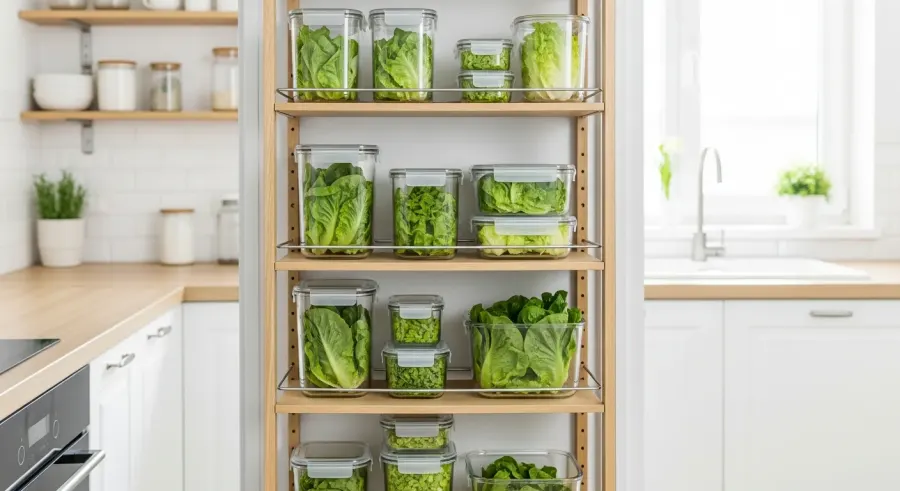
In Short
Keep lettuce in a high-humidity crisper drawer between 32°F and 35°F, and store it far away from apples or avocados. The surprisingly simple chemistry behind why nearby fruit ruins your romaine (and what those weird pink stains actually mean) is below.
There is a very specific disappointment in buying a beautiful, crisp head of romaine only to find it dissolving into a dark puddle a few days later. Lettuce is a notoriously fragile thing, essentially just crunchy water wrapped in a delicate cellular matrix. Managing its environment is entirely about finding the exact balance between too dry and too wet.
Getting the crisper drawer right
Most of us just toss our greens wherever they fit, but if you want to know how to store lettuce in the fridge properly, you have to respect its structure. Lettuce relies entirely on turgor pressure—the water filling its cells—to stay crisp. When it loses water, it wilts. When it sits in a puddle of water, it rots.
For optimal crispness, lettuce needs to be kept between 32°F and 35°F (0°C to 1.6°C). If the temperature drops below 31.7°F, the leaves sustain freezing injury. If it creeps up past 40°F, bacterial growth accelerates rapidly.
The crisper drawer is your best tool for this, assuming the settings are right. Lettuce requires a high-humidity environment, ideally around 95 percent relative humidity (Rutgers New Jersey Agricultural Experiment Station). To achieve this, close the vents on your crisper drawer. This traps the moisture that leafy greens naturally release as they sit.
There is a catch. While lettuce needs high atmospheric humidity to prevent wilting, sitting in actual condensation causes rapid decay. This is where the classic paper towel trick proves its worth. Wrapping a whole head of lettuce or lining a container of loose leaves with a dry paper towel absorbs the excess liquid water while keeping the surrounding air perfectly moist.
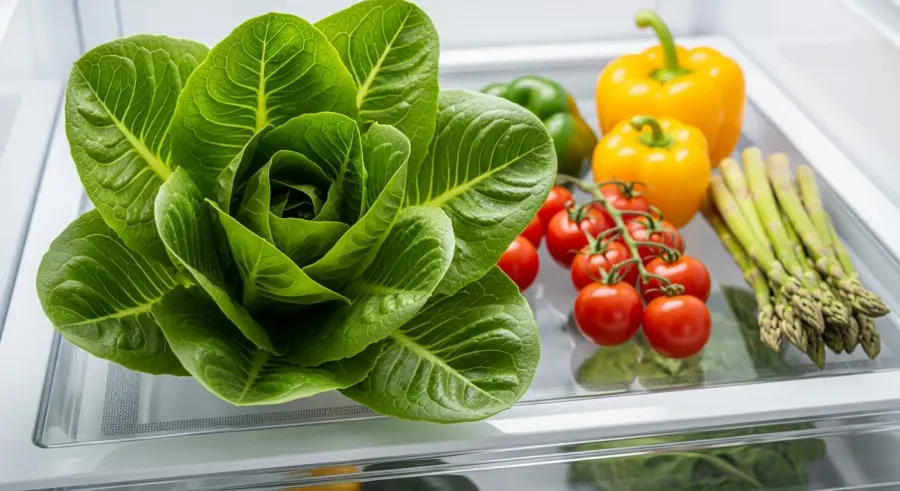
The fruit that ruins your greens
Those rusty, reddish-brown freckles you sometimes see creeping up the thick white ribs of romaine are not a disease. They are scars from an invisible chemical reaction.
Lettuce is highly sensitive to ethylene, a naturally occurring gas that many fruits emit as they ripen. While apples, pears, avocados, and melons pump out high volumes of ethylene, leafy greens just quietly absorb it. When lettuce is exposed to this gas in an enclosed space like a refrigerator, it triggers a condition known in agriculture as russet spotting. The gas accelerates cellular aging, causing the plant tissue to break down and form those dry, brown spots. It also speeds up the degradation of chlorophyll, turning dark green leaves a sickly yellow.
You can prevent this by treating your fridge like a middle school dance and keeping the two groups completely separated. Put your ethylene-producing fruits in a low-humidity drawer with the vent open, and keep your lettuce in the high-humidity drawer on the opposite side of the appliance.
The clock starts when you cut it
Buying whole heads of lettuce is not just a budget decision. It offers a massive structural advantage.
An intact head of iceberg or romaine has a natural defense system. The inner leaves are protected from oxygen and physical damage by the sturdy outer layers. Stored correctly in the fridge, the lettuce shelf life of a whole head of iceberg can stretch to three or four weeks. Looser heads like romaine or butter lettuce generally hold up for one to two weeks.
The moment a knife slices through those leaves, the biological clock speeds up. Cutting ruptures the cell walls, releasing enzymes that react with oxygen and triggering rapid oxidation. This is why bagged, pre-chopped salads have such a notoriously short shelf life. Once you chop lettuce at home, you have roughly three to five days before it starts deteriorating.
When storing cut lettuce, use a hard-sided, airtight container rather than a plastic bag. A rigid container protects the delicate torn edges from getting bruised every time you rummage through the fridge. Additionally, tearing leaves by hand along their natural cellular fault lines causes slightly less damage than slicing them with a dull knife, which can buy your prepped greens an extra day of crispness.
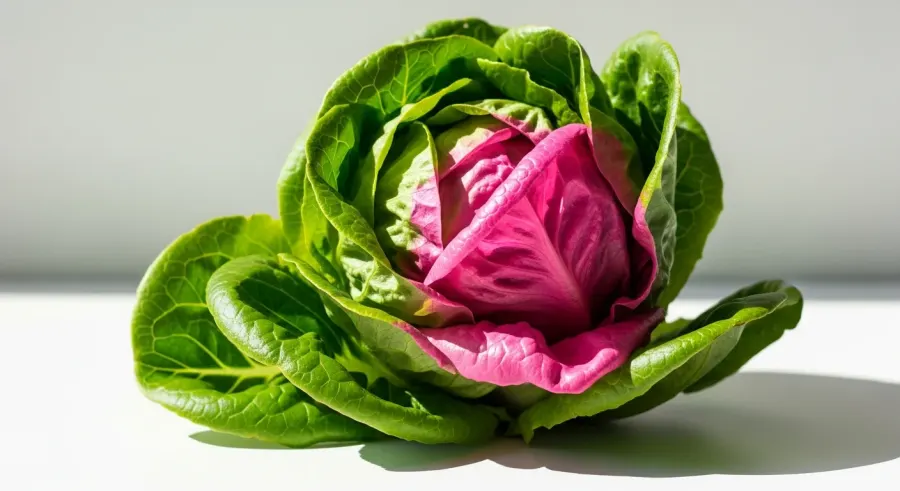
Wait, what does the pink mean?
Finding a bright pink stain at the base of a lettuce head can be a little alarming. It looks synthetic, almost like someone spilled food coloring in the crisper drawer.
This discoloration is a physiological stress response known simply as pink rib. It usually happens when lettuce is harvested past its prime or stored at slightly higher-than-ideal temperatures. A study highlighted by researchers at the University of Florida found no presence of decay-causing fungi or microorganisms associated with pink rib. It is entirely harmless. The affected leaves might taste a fraction more bitter than normal, but they are perfectly safe to eat.
Knowing the real lettuce spoilage signs saves you from throwing away perfectly good food. When actual bacterial decay sets in—often from a strain like Pseudomonas marginalis—the cellular structure collapses completely. The leaves become dark, wet, and slimy, accompanied by a distinct, unpleasant odor. At that point, the lettuce is unrecoverable and belongs in the compost.
Why freezing ruins the crunch
You might wonder if you can just freeze lettuce before it goes bad, similar to how you would save spinach or kale. You can, but you have to understand exactly what happens to the texture.
Iceberg lettuce is over 95 percent water, and it freezes at approximately 31.7°F (-0.2°C). Dropping it below this temperature causes microscopic ice crystals to form inside the plant tissue. Because water expands when it freezes, these jagged little ice crystals puncture the delicate plant cell walls from the inside out.
While the lettuce remains safely frozen, you will not notice a difference. The problem reveals itself the moment it thaws. The damaged cells lose all their turgor pressure, and the crisp, rigid leaves collapse into a dark, translucent, water-soaked puddle. You can absolutely still use frozen lettuce by dropping it directly into a blender for a green smoothie, but it will never work in a fresh salad again.
The counter is the enemy
Leaving lettuce out on the kitchen counter does more than just make it limp. The ambient temperature of a normal kitchen triggers a rapid breakdown of the vegetable's nutritional profile.
According to USDA FoodData Central, a 100g serving of green leaf lettuce provides about 9.2 mg of Vitamin C. However, vitamin retention depends heavily on temperature. A 2010 study published in the journal Ciência & Saúde Coletiva tracked vitamin loss in commercial kitchens and found that leaving vegetables at room temperature caused rapid degradation of ascorbic acid. Other research has noted that lettuce stored near freezing (around 0°C to 2°C) retains significantly higher concentrations of vitamins compared to heads stored in warmer environments.
Every hour your groceries spend sitting in a warm car or on the kitchen counter diminishes both their physical crunch and their nutritional value. Getting them into the cold immediately is the best way to preserve what you bought.
Bottom Line
A head of lettuce is a living thing slowly winding down. By controlling the temperature, managing the moisture, and keeping it away from ripening fruit, you are simply pausing the clock. It doesn't require a complicated system, just a little respect for the fragile chemistry of a green leaf.