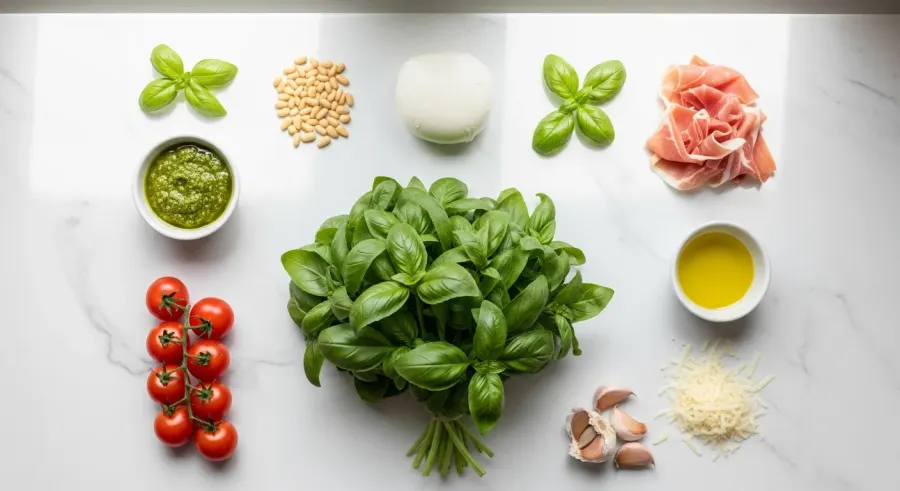
In Short
Spinach offers the closest structural match without altering the classic texture, while arugula provides a spicy, peppery upgrade. The exact ratios for these (and why purely dried basil ruins the emulsion) are detailed below.
Pesto is fundamentally an emulsion, not a strict recipe. While Genovese tradition relies heavily on sweet basil, the mechanics of blending fat, nuts, cheese, and greens are highly forgiving if you understand the underlying chemistry. Swapping out the primary herb changes the moisture content, the volatile aroma compounds, and the physical breakdown of the sauce.
Spinach Is Your Best Bet
You might already have a bag of this sitting in the crisper drawer. Spinach is the closest structural twin to basil when you need to build the foundation of a pesto. The ratio is exactly one-to-one: use one cup of tightly packed raw spinach for every cup of basil your recipe calls for.
The reason spinach performs so reliably comes down to its water content and cellular fragility. When the food processor blades hit the leaves, spinach breaks down into a smooth, vibrant green paste that emulsifies beautifully with olive oil. Flavor-wise, it is a completely blank canvas. Fresh basil owes its signature aroma to compounds like eugenol (which smells like cloves) and linalool (which provides floral and citrus notes). Spinach possesses none of these. It simply tastes green and mild, which allows your garlic, toasted pine nuts, and Parmigiano-Reggiano to completely dominate the palate.
Looking at the numbers from USDA FoodData Central, the nutritional profiles are remarkably aligned. Basil sits at 23 calories per 100g, and raw spinach matches it exactly at 23 calories. Spinach delivers 2.9 grams of protein compared to basil’s 3.15 grams, and contains 0.4 grams of total fat versus basil’s 0.64 grams.
This substitute excels in classic applications where you want the cheese and nuts to shine, like tossing with hot linguine or spreading on a chicken sandwich.
A distinct failure case happens if this spinach pesto is stirred into a heavily simmering tomato sauce on the stove. Because spinach releases its internal water rapidly when exposed to sustained heat, cooking the pesto causes the olive oil to separate, leaving a broken, greasy puddle on top of the pasta.
Arugula Brings Serious Bite
At 25 calories per 100g, arugula packs a surprisingly aggressive flavor profile. You can substitute it at a strict one-to-one ratio, but the resulting sauce will bear very little resemblance to a traditional sweet Genovese pesto.
Arugula belongs to the Brassica family, and its defense mechanism is chemical. When you chew or process arugula leaves, enzymes rapidly convert stored glucosinolates into isothiocyanates. These are the exact same compounds that give mustard and horseradish their sinus-clearing heat. As the food processor runs, the arugula becomes progressively spicier. This pepperiness slices right through the heavy fats of the olive oil and nuts, creating a highly balanced, sharp condiment.
The nutritional shift is minimal but present. USDA FoodData Central lists raw arugula at 2.6 grams of protein and 0.7 grams of total fat per 100g. It lacks the eugenol of basil, replacing those sweet clove notes with a deep, earthy nuttiness.
Arugula pesto is brilliant when used as a base spread for a prosciutto pizza, or tossed into cold pasta salads where the spicy bite can act as a counterbalance to sweet cherry tomatoes.
This substitute falls apart completely when plated with delicate seafood. The robust, mustard-like oils in processed arugula easily bulldoze the mild, nuanced flavors of scallops, white fish, or butter-poached crab, leaving a spice that lingers long after the seafood flavor fades.
Flat-Leaf Parsley Keeps It Earthy
Ever notice how parsley seems to end up as a garnish rather than the main event? In a pesto, flat-leaf parsley finally gets to carry the weight of a sauce. You can swap it at a one-to-one ratio for fresh basil.
Parsley works exceptionally well because its fibrous stems and leaves break down into a sturdy paste that oxidizes much slower than basil. Basil is notorious for turning brown within minutes of being chopped due to high levels of polyphenol oxidase. Parsley remains a vivid, bright green for days in the fridge. The flavor is heavily driven by aroma compounds like myrcene and apiol, giving the sauce a woody, intensely fresh earthiness.
It is slightly denser nutritionally. USDA FoodData Central data shows fresh parsley at 36 calories per 100g. It provides 2.97 grams of protein and 0.79 grams of fat. Because the leaves contain slightly less water than basil, you might find the pesto looks a bit dry; adding an extra splash of olive oil will easily correct the viscosity.
This variation is perfect for heavy meats. Drizzle it over grilled flank steak or roasted root vegetables, where it acts very similarly to a thick Argentine chimichurri.
Curly parsley presents a massive textural problem. The physical architecture of curly parsley traps large amounts of air during the blending process. Instead of a tight, dark emulsion, the result is a frothy, pale, aerated paste that feels bizarre on the tongue.
Kale Requires A Little Prep
The structural integrity of kale is both its biggest strength and its main drawback in a sauce. Substituting kale for basil requires a one-to-one ratio of the leaves, but demands an extra step of preparation.
Kale is dominated by rigid cellulose and tough fibers. If you drop raw kale directly into a food processor with oil and nuts, it simply will not break down. You will be left with a grassy, hard-to-chew paste. To make this work, you must blanch the kale leaves in boiling water for thirty seconds, then immediately plunge them into an ice bath. This brief heat exposure tenderizes the cell walls and halts enzymatic browning.
Once blanched and squeezed dry, kale creates a thick, hearty sauce. It tastes deeply earthy with a slight sulfurous bitterness that pairs beautifully with toasted walnuts. According to USDA FoodData Central metrics, a 100g serving of raw kale sits at 35 calories, bringing 2.9 grams of protein and 1.5 grams of fat to the bowl. That higher fat content, combined with the dense cellular structure, makes for a much heavier pesto.
Spoon this over dense winter grain bowls, or fold it into ricotta cheese to form a rich layer for a baked lasagna.
This heavy mixture struggles in light summer pasta dishes. The sheer physical weight of the kale paste drags down delicate noodles like angel hair, clumping the pasta together rather than coating it.
Carrot Tops Work Surprisingly Well
Throwing away the leafy green stems of root vegetables is a relatively modern habit. Carrot tops make a surprisingly nuanced pesto, and you can substitute them for basil at a one-to-one ratio by volume.
The feathery, delicate texture of the upper fronds breaks down easily in a food processor. They carry a flavor that tastes like a hybrid between flat-leaf parsley and mild, sweet carrots. Volatile compounds like beta-myrcene found in carrot foliage contribute a distinct piney, herbaceous aroma. This scent overlaps nicely with the pine nuts traditionally used in the sauce.
Carrot tops are highly fibrous, so they require about forty-five seconds of additional blending time compared to delicate basil leaves to achieve a truly smooth mouthfeel.
This variation shines when spooned directly over roasted carrots, creating a closed-loop dish. It also works beautifully folded into plain yogurt to make a quick vegetable dip.
The thick lower stalks of the carrot greens present a strict boundary. The rigid stems contain a highly concentrated dose of those terpene volatiles. If processed into the sauce, the pesto takes on an astringent, chemical flavor resembling wood polish. The soft, feathery upper leaves are the only usable part.
Mint Needs A Milder Partner
Using pure mint as a one-to-one replacement will ruin your dinner. Mint and basil belong to the same botanical family (Lamiaceae), which means they share some morphological traits, but their chemical payloads are entirely different.
Mint contains high concentrations of menthol, a compound that triggers the cold sensors on your tongue. If you use a full cup of mint in place of a cup of basil, the resulting sauce tastes overwhelmingly like garlic-flavored toothpaste. To utilize mint successfully, you must dilute it with a neutral structural base. The correct ratio is one-quarter cup of fresh mint leaves combined with three-quarters of a cup of fresh spinach, replacing one cup of basil.
The spinach provides the necessary volume, water, and green color, while the mint acts as an aromatic accent. USDA FoodData Central logs fresh peppermint at roughly 70 calories per 100g, with 3.8 grams of protein and 1 gram of fat, though you will be using it in much smaller quantities. The fat from the olive oil and cheese coats the palate, slightly subduing the aggressive menthol while letting the bright, sweet notes cut through.
This modified pesto is brilliant when paired with spring ingredients. Toss it with fresh pea ravioli, spread it over roasted lamb chops, or mix it into a pistachio-based pesto where the sweet nuts complement the herb.
This combination clashes violently with heavy, tomato-based dishes or rich beef preparations. The cooling effect of the menthol fundamentally disagrees with deep, savory red meat profiles, creating a jarring contrast on the palate.
When To Settle For Dried Basil
Sometimes the pantry is bare and the craving is immediate. Reaching for a jar of dried basil is a natural instinct when making pesto, but using it as a direct substitute is a mechanical disaster.
Pesto relies on the water trapped inside fresh leaves to help form an emulsion with the olive oil. Dried basil has zero moisture. Furthermore, the dehydration process evaporates the delicate citrus and floral volatiles, leaving behind a dusty, highly concentrated version of the herb.
If you blend dried basil directly with oil, nuts, and cheese, you will create a gritty, abrasive sludge that separates immediately.
To make dried basil work, you have to reconstruct the fresh leaf. Use one tablespoon of dried basil paired with one tightly packed cup of fresh spinach to replace a single cup of fresh basil. The spinach provides the missing cellular water and physical bulk, while the dried basil imparts the characteristic eugenol (clove) flavor.
This hybrid approach works well for baked applications. If you are stuffing jumbo pasta shells and baking them in the oven for forty-five minutes, the prolonged heat allows the dried herb fragments to fully hydrate and soften into the surrounding cheese.
This dried basil and spinach trick fails entirely in raw, cold applications like a Caprese pasta salad. The dried flakes do not receive enough time or heat to soften, leaving a distinct, sandy texture in every bite.
Bottom Line
A good pesto is less about rigid adherence to a specific leaf and more about understanding the mechanics of an emulsion. Fat, salt, acid, and fresh greens will always find a way to work together, provided you respect the unique properties of whatever plant you drop into the food processor.