In Short
Swallowing an intact cherry pit is harmless because your stomach acid cannot break its outer shell. The seeds do contain a chemical that converts to cyanide, but you would have to manually crush and eat over a hundred pits to reach a toxic dose.
You are eating a handful of fresh sweet cherries, and suddenly one slips past your teeth. You swallow it whole. Immediately, a childhood warning echoes in your head about the deadly poison hidden inside.
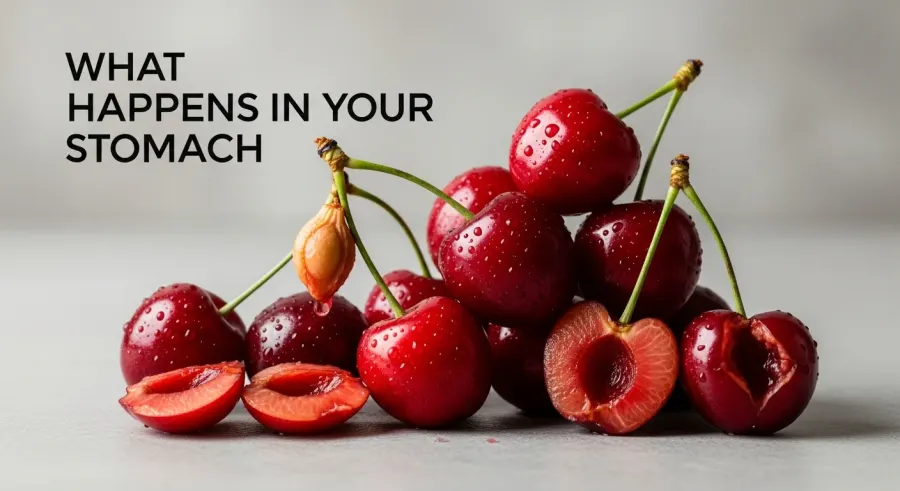
What Happens in Your Stomach
If you just swallowed an intact pit, you can relax. Human digestion is simply no match for the dense, woody endocarp of a stone fruit.
The pit is essentially a biological vault designed by evolution to survive a trip through the digestive tract of a foraging animal. When it lands in your stomach, your hydrochloric acid goes to work. This acid maintains a pH between 1.5 and 3.5, which is strong enough to break down muscle fibers and complex proteins. It cannot, however, penetrate the lignin shell of a cherry pit.
Because the shell remains unbroken, whatever is locked inside stays completely sealed. The pit travels down through your small intestine, navigates the large intestine, and eventually exits your body in your stool a day or two later. It undergoes almost zero chemical changes along the way. Your body treats it exactly like a small pebble.
This is not a biological accident. Cherries evolved to be eaten by birds and mammals. The plant wants the sweet flesh to be consumed so the seed can be carried away and deposited in a new location, conveniently wrapped in a small packet of fertilizer. If the pit were easily dissolved by digestion, the cherry tree would never reproduce.
The Two-Part Defense System
Plants cannot run away from predators. They have to rely on chemical warfare to protect their seeds from animals that might want to chew them up rather than swallow them whole.
People often claim that cherry pits are full of liquid cyanide. That is a misunderstanding of the botanical chemistry. The kernel inside the pit does not contain free-floating poison. Instead, it contains a cyanogenic glycoside called amygdalin. On its own, amygdalin is completely harmless. It is a stable precursor molecule.
For the seed to become toxic, the amygdalin must mix with a specific enzyme, usually beta-glucosidase. The plant cleverly stores the amygdalin in one cellular compartment and the enzyme in another. As long as the seed remains intact, the two chemicals never meet.
When a rodent or a human decides to chew the pit, the mechanical crushing breaks down those cellular walls. The amygdalin and the enzyme mix together in the presence of moisture. This triggers a chemical reaction that cleaves the molecule apart, releasing hydrogen cyanide gas. It functions exactly like snapping a glow stick to mix the chemicals inside.
The poison is only created at the exact moment the seed is destroyed.
Doing the Toxicity Math
Getting sick from cherries requires serious, intentional effort.
The threshold for human cyanide toxicity is roughly 0.5 to 3.5 milligrams per kilogram of body weight (Healthline, 2026). For a 150-pound adult, that means a toxic dose starts somewhere around 30 to 34 milligrams of actual hydrogen cyanide.
Different cherries have different chemical concentrations. A typical red cherry pit contains about 3.9 milligrams of amygdalin per gram of seed tissue, while black cherries contain slightly less at 2.7 milligrams (Tasting Table, 2023).
If you want to get nerdy about the chemistry, many online panic-articles confuse these two numbers. They assume 3.9 milligrams of amygdalin equals 3.9 milligrams of cyanide. It does not. The molecular weight of amygdalin dictates that it yields only about 5.9% of its mass as hydrogen cyanide gas.
That means 3.9 milligrams of amygdalin generates just 0.23 milligrams of actual cyanide.
To reach the minimum danger threshold of 30 milligrams, an adult would have to manually crush and consume the kernels of roughly 130 cherry pits in a single sitting. Breaking a cherry pit with human molars is difficult and deeply uncomfortable. Your teeth would likely chip before you managed to grind down enough pits to endanger your life.
Blenders Change the Rules Entirely
What human molars struggle to accomplish, modern kitchen appliances handle with ease.
Most accidental exposures today involve high-speed blenders. A widely documented case reviewed by regional poison control centers involved a 14-year-old boy who decided to make a fresh fruit smoothie. He tossed ten whole cherries into the blender, pits and all.
The steel blades easily pulverized the hard endocarp, exposing the soft kernels. The blending process thoroughly mixed the amygdalin and the enzymes into the liquid of the smoothie, accelerating the chemical reaction before he even took a sip.
A few hours after drinking it, the boy became pale, sweaty, and highly nauseated. He developed a severe headache and physical tremors. These are the classic early warning signs of mild cyanide toxicity. He was evaluated at a local emergency room, monitored, and fully recovered within 19 hours without any permanent damage.
The lesson here is strictly mechanical. You do not need to fear the fruit, but you should keep stone fruit seeds out of the Vitamix.
What Cyanide Does to Cells
The fear of this chemical comes from its microscopic efficiency.
Hydrogen cyanide does not burn your stomach lining or stop your heart instantly like a theatrical poison. It works at a deep, cellular level to starve your tissue of oxygen. The chemical binds to an enzyme in your mitochondria called cytochrome c oxidase.
Mitochondria handle cellular respiration. They are responsible for turning the oxygen you breathe and the glucose you eat into usable energy, known as ATP. When cyanide binds to that specific enzyme, it acts like a microscopic off-switch for your entire energy grid.
Even if your lungs are breathing perfectly and your blood is carrying plenty of oxygen, your cells suddenly cannot use it. The body begins to suffocate from the inside out.
This explains why the initial symptoms are dizziness, confusion, and a pounding headache. The brain is the most oxygen-hungry organ in the human body, so it registers the shortage long before the muscles do.
Fortunately, the human body is not defenseless. We have a natural filtration system. An enzyme in our liver called rhodanese can process very small amounts of ambient cyanide, converting it into a harmless compound called thiocyanate that simply flushes out in your urine. A single crushed cherry pit is easily handled by your liver's standard background operations.
Apples and Plums Do It Too
Cherries bear the brunt of the cultural paranoia, but they are not unique.
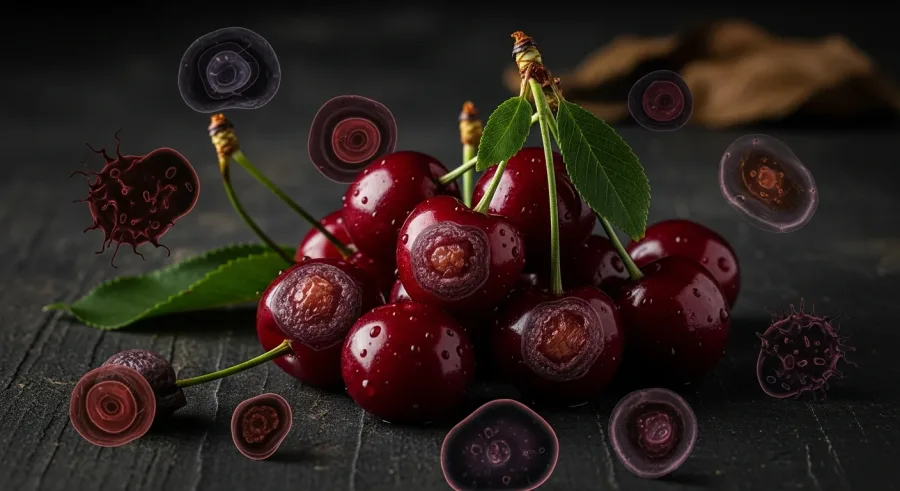
The entire Prunus genus relies on this exact chemical defense mechanism. Apricots, peaches, plums, nectarines, and almonds are all closely related, and they all utilize amygdalin to protect their reproductive future.
In fact, cherries are on the weaker end of the spectrum. A 2022 study published in the journal Agricultura compared the cyanide potential of different stone fruit pits using a highly sensitive picrate paper method. The researchers found that gages (a specific, sweet subspecies of plum) had significantly higher cyanide-producing potential than cherries, reaching up to 310 micrograms per gram.
Even fruits outside the stone fruit family use this trick. Apples and pears, which belong to the broader Rosaceae family, keep amygdalin tucked inside their tiny black seeds.
The primary difference is just scale and anatomy. An apricot pit is large enough that a single crushed kernel contains a meaningful volume of the compound. Cherry pits and apple seeds are so small that a single crushed instance is merely a biological nuisance.
That Distinct Amaretto Smell
There is a sensory clue hidden in this process.
When beta-glucosidase breaks down amygdalin, it does not just release hydrogen cyanide. The reaction also produces benzaldehyde. This specific chemical is responsible for the distinct, sharp aroma of bitter almonds.
If you ever crack open a cherry pit with a hammer, or if you accidentally bite deeply into an apple seed, you might notice a sudden waft of amaretto. It smells exactly like marzipan.
This is not a coincidence. True bitter almonds are also members of the Prunus family and contain massive amounts of amygdalin. Human noses evolved to be highly sensitive to this scent as a protective measure, warning us of the chemical reaction happening right in front of us.
In the culinary world, that almond note is highly prized, which leads to a fascinating historical paradox. For thousands of years, humans have intentionally sought out the very seeds that are trying to poison them just to capture that smell.
How People Actually Eat Them
Humans have known about this botanical armor for centuries, and we figured out a way around it.
In many parts of the Middle East and the Mediterranean, the pits of the Mahaleb cherry (Prunus mahaleb) are cracked open to harvest the soft, teardrop-shaped kernel inside. These kernels are ground into a powder to create a spice called mahlab. It adds a rich, complex, bitter-almond flavor to breads, cookies, and pastries.
In France, the kernels of apricots and cherries are historically used to make noyaux, an almond-flavored extract or liqueur.
The secret to all of these culinary traditions is heat.
Heating the kernels through roasting, boiling, or baking denatures the enzymes required to convert the amygdalin into hydrogen cyanide. Without the active enzyme, the chemical reaction is permanently stalled. The amygdalin remains inert and harmless in your digestive tract, but the aromatic compounds survive to flavor the food.
It requires careful processing by someone who understands the technique, but it proves that the seed is not universally off-limits.
The Physical Danger Nobody Mentions
When medical professionals worry about stone fruit, they are rarely thinking about toxicology.
For adults, swallowing a handful of intact pits might cause mild gastrointestinal discomfort simply because they are hard, indigestible objects navigating the delicate lining of the digestive tract. They take up space and do not break down.
For young children, the concern is much more immediate. The real threat is choking.
The smooth, perfectly round shape of a cherry pit makes it incredibly easy to slip past the tongue unchewed. Its size is just large enough to block a pediatric airway. In some rare cases, swallowing a large volume of pits has led to intestinal blockages that required mechanical intervention.
During the summer months, local poison control centers field frequent calls from panicked parents about swallowed cherry pits. Their standard medical advice is rarely to rush to the hospital for a cyanide antidote. Instead, they simply advise monitoring the child to ensure they are breathing comfortably and not experiencing severe stomach pain as the pit makes its slow journey outward.
Bottom Line
A cherry is a masterclass in survival. It wraps its reproductive future in a shell strong enough to defeat stomach acid, arms it with a chemical defense against chewing predators, and wraps the whole package in a sugary lure. Swallowing one is just participating in a very old biological transaction.