In Short
Green, yellow, and red peppers aren't always different plants—they are often just stages of ripening. But lobe-based gender myths and non-climacteric chemistry reveal that almost everything we assume about their color changes is wrong. What actually happens on the vine is below.
If you have ever wondered why do bell peppers change color, the internet usually offers a simple answer: they are all the exact same plant, just picked at different times. The agricultural reality is much stranger than that.
Wait, Are They All the Same Plant?
Many people recently discovered an internet factoid claiming that green, yellow, orange, and red peppers are all the exact same vegetable, just picked at different points in their lifespan. You plant a seed, it grows a green fruit, and if you wait long enough, it turns red.
It is a neat, tidy narrative. It is also only partially true.
Most colored peppers do begin their lives as green fruits, heavily laden with chlorophyll. As they mature, the chlorophyll breaks down, stripping away the green mask to reveal other pigments underneath. But the idea that every yellow pepper is just a red pepper that was picked too early ignores the reality of agricultural genetics.
The true color-coding comes down to a specific piece of genetic code called the Ccs gene. According to research published in the Journal of Experimental Botany (2007), this gene produces an enzyme called capsanthin-capsorubin synthase. That enzyme has one job: it synthesizes the heavy red pigments that give mature peppers their crimson hue.
Some pepper varieties carry a natural mutation in this exact gene. A deletion or a premature stop-codon means the plant physically cannot produce the enzyme. Without it, the ripening process hits a biological wall. The chlorophyll fades, leaving behind a baseline of yellow and orange carotenoids like lutein and beta-carotene, but the fruit will never turn red, no matter how long it sits on the vine.
A yellow pepper is not a lazy red pepper. It is a genetically distinct fruit that simply lacks the chemical machinery to paint itself red.
The Bizarre Myth About Pepper Genders
Have you ever been told to flip a pepper over in the grocery store?
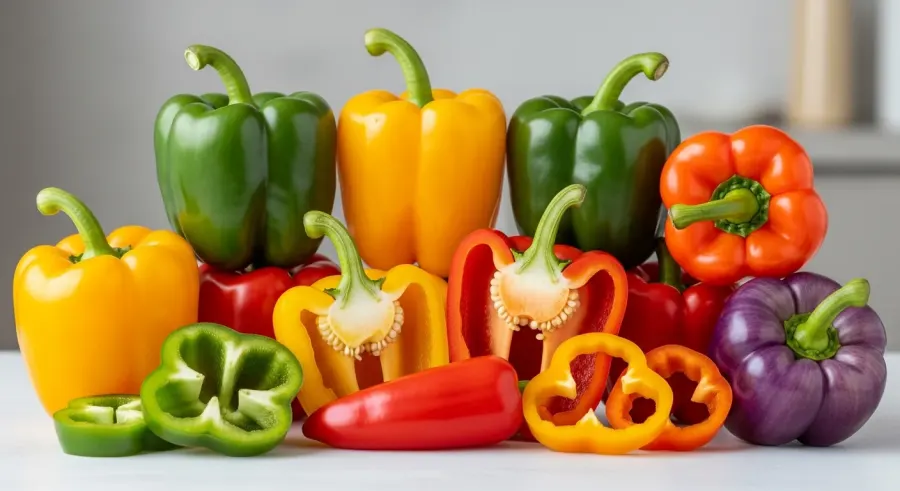
The advice usually goes something like this: If the bottom has three bumps (or lobes), it is a "male" pepper, which means it has fewer seeds and is better for cooking. If it has four lobes, it is a "female" pepper, which means it is sweeter and better for eating raw.
This is entirely false.
Peppers do not have genders. As the Iowa State University Extension politely points out, bell peppers develop from what botanists call a "perfect" flower. This means the flower contains both male pollen-producing stamens and female ovule-bearing pistils. The fruit itself is just a ripened botanical ovary. Assigning a gender to a bell pepper makes about as much sense as assigning a gender to a human thumb.
The number of lobes on the bottom is dictated by the genetic variety of the seed and the specific environmental conditions the plant experienced while growing. It has zero correlation with the seed count inside, and it certainly does not dictate the sugar content.
Sweetness is determined by how long the fruit was allowed to ripen on the plant, not by its structural geometry. The lobe myth likely survives because humans love a simple visual heuristic, especially when standing in the produce aisle trying to guess which vegetable will taste best in a salad. We want a visual shortcut for flavor. Unfortunately, the bumps on the bottom provide no actual data.
That Signature Smell Is Exactly One Chemical
Cutting into a fresh green pepper releases an aroma so distinct it instantly fills the kitchen. It is sharp, grassy, and unmistakably vegetal.
That scent is almost entirely the work of a single chemical compound known as 2-methoxy-3-isobutylpyrazine. Flavor chemists often just refer to it as bell pepper pyrazine.
Human biology is uniquely attuned to nitrogen-containing compounds like pyrazines. We can detect this specific molecule at a concentration of roughly two parts per trillion (Journal of Agricultural and Food Chemistry, 1969). To visualize that kind of sensory extreme, imagine a single drop of liquid diluted evenly throughout an entire Olympic-sized swimming pool. If that drop were bell pepper pyrazine, your nose would still register it.
As the pepper matures on the vine and changes color, the concentration of these pyrazines plummets. This is why a fully red or orange pepper lacks that aggressive, grassy bite and instead smells mellow and fruity. The chemical alarm bell has been turned off.
Interestingly, you will find this exact same compound in the wine aisle. The green, herbaceous notes in certain Cabernet Sauvignons and Sauvignon Blancs are caused by the very same pyrazine. Winemakers actually have to manage their vine canopies carefully to ensure enough sunlight hits the grapes to degrade the pyrazines before harvest, otherwise the resulting wine might taste strongly of unripe vegetables.
Why Leaving Them on the Counter Fails
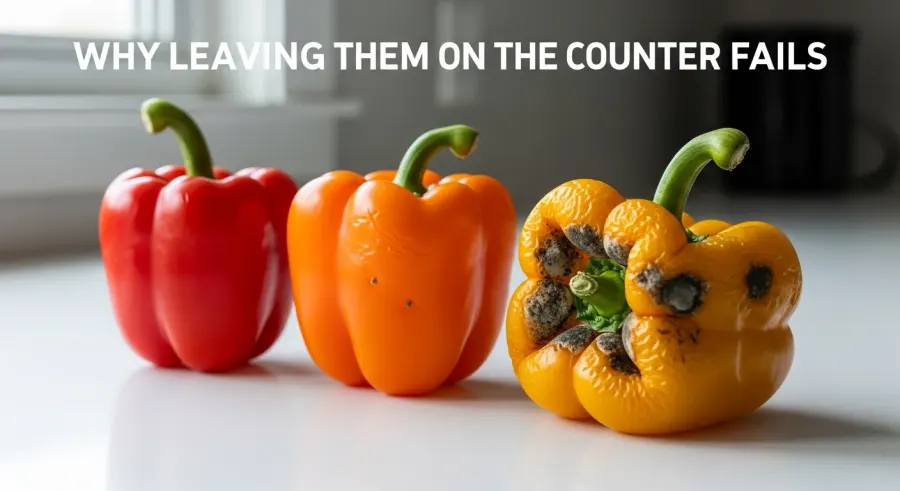
At some point, almost everyone has left a green pepper on the kitchen counter for a week, only to watch it slowly develop a muddy red or orange blush. It looks like it is ripening.
It isn't.
Fruits are broadly categorized into two groups based on how they behave after harvest: climacteric and non-climacteric. Climacteric fruits, like tomatoes, bananas, and avocados, have an internal chemical switch triggered by ethylene gas. Once picked, they continue the biochemical process of ripening. Starches convert to sugars, acids drop, and flavors develop while sitting in your fruit bowl.
The American Society for Horticultural Science classifies bell peppers as a non-climacteric fruit. They lack this ethylene-sensitive trigger. The moment a grower cuts the stem, the true ripening process stops permanently.
When a counter-bound green pepper changes color, you are simply watching senescence—the slow degradation of plant tissue. The green chlorophyll breaks down due to time and oxygen exposure, revealing the other pigments that were already present underneath. But the plant is no longer pumping carbohydrates into the fruit, meaning no new sugars are being created. A green pepper that turns red in your kitchen will taste exactly like a green pepper. The texture will just be softer and slightly sadder.
What Happens to the Carbohydrates
Look closely at the nutritional data for a raw green bell pepper. A strict baseline reading for 100 grams reveals a very lean profile: exactly 0.72 grams of protein, a tiny trace of fat (0.11 grams), and roughly 4.78 grams of carbohydrates.
Those 4.78 grams of carbohydrates are mostly structural. They are complex starches holding the rigid walls of the fruit together.
When the pepper is allowed to change color naturally on the vine, a massive metabolic shift occurs. The plant begins actively breaking down those complex carbohydrates and converting them into simpler, sweeter sugars like fructose and glucose. This is the physiological reality of sweetness.
The color change is essentially a biological billboard. In the wild, the plant uses the bright red or orange pigment to signal to passing animals that the starches have been dismantled, the sugars are ready, and the seeds inside are mature enough to be eaten and dispersed.
Because this carbohydrate conversion requires immense energy and resources from the root system, it cannot happen once the pepper is harvested. The mother plant acts as a continuous supply line. Sever the connection, and the carbohydrate profile is frozen exactly where it stands.
The Pigment That Barely Exists Anywhere Else
The deep, vibrant crimson of a fully ripe bell pepper does not come from the same pigments that color apples or strawberries. Red fruits often rely on anthocyanins for their blush, but peppers manufacture something highly specialized.
The vast majority of that red hue comes from a single carotenoid called capsanthin.
Capsanthin is rarely found in nature outside of the Capsicum genus. In a fully mature red pepper, this specific pigment can account for up to 80% of the total carotenoid content. It is a heavy, stable molecule that gives paprika its staining power and distinct color.
The plant does not just produce capsanthin for aesthetics. As the fruit sits in the direct sun for weeks waiting for its seeds to mature, it faces severe oxidative stress from ultraviolet radiation. Capsanthin acts as a powerful localized antioxidant, protecting the cellular structure of the fruit from breaking down before an animal can come along to eat it.
The longer the pepper stays on the vine, the more capsanthin it builds up. This is the main reason why red bell peppers are consistently the most expensive option at the grocery store. They require the most time, the most water, the most sunlight, and the most protection from pests while the farmer waits for that final, brilliant pigment to synthesize.
Bottom Line
The next time you slice into a red pepper, you aren't just looking at a salad ingredient. You are looking at a botanical timeline—weeks of solar energy, complex carbohydrate conversions, and highly specialized pigment synthesis, all frozen the exact second it was cut from the vine.