In Short
The white powder on blueberries is a natural protective wax called the bloom. Without this microscopic shield scattering UV light, blueberries wouldn't even look blue—they'd appear dark red.
You open a fresh pint of berries from the market, and there it is. A cloudy, silvery film coating almost every single one. If you’ve ever stopped mid-snack to wonder what that dusty residue actually is, the answer involves a clever optical illusion, avian vision, and a very persistent rumor about farming chemicals.
Wait, Blueberries Aren't Actually Blue?
Squish a cherry on your kitchen counter, and you get bright red juice. Squish a blackberry, and your fingers turn a deep, dark purple. But if you mash a blueberry, you might notice something strange. There is no blue pigment inside. The flesh is pale, and the juice is a dark, dull red.
For a long time, the exact mechanism of a blueberry's color was just accepted without much thought. We knew they contained anthocyanins—the same dark red pigments found in eggplants and red cabbages. But a February 2024 study published in the journal Science Advances finally explained the trick. Researchers at the University of Bristol discovered that a blueberry's color doesn't come from the pigment inside the fruit at all. It comes entirely from that white, dusty powder on the outside.
The powder forms a microscopic, highly complex crystalline structure on the surface of the skin. When light hits these random, non-spherical structures, they scatter blue and ultraviolet (UV) light right back at your eyes. This phenomenon is known as structural color. It is the exact same physics trick that gives peacock feathers and morpho butterflies their iridescent hues, even though they lack colored pigments.
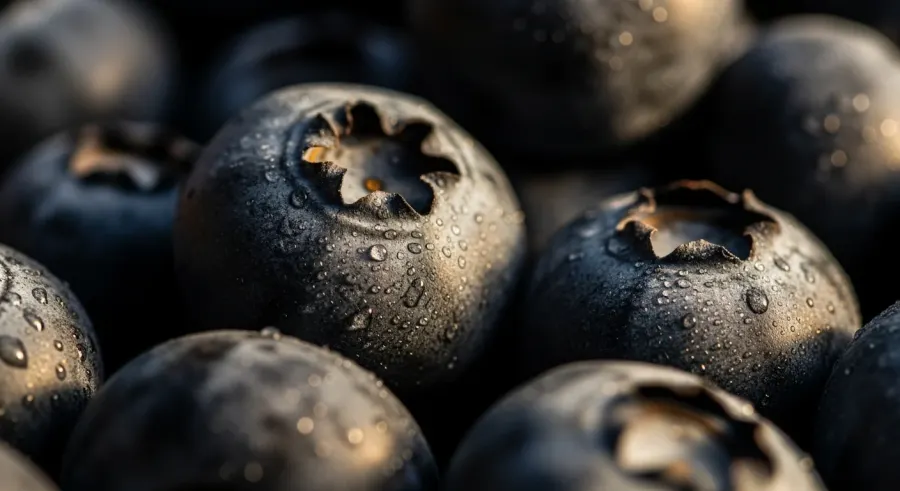
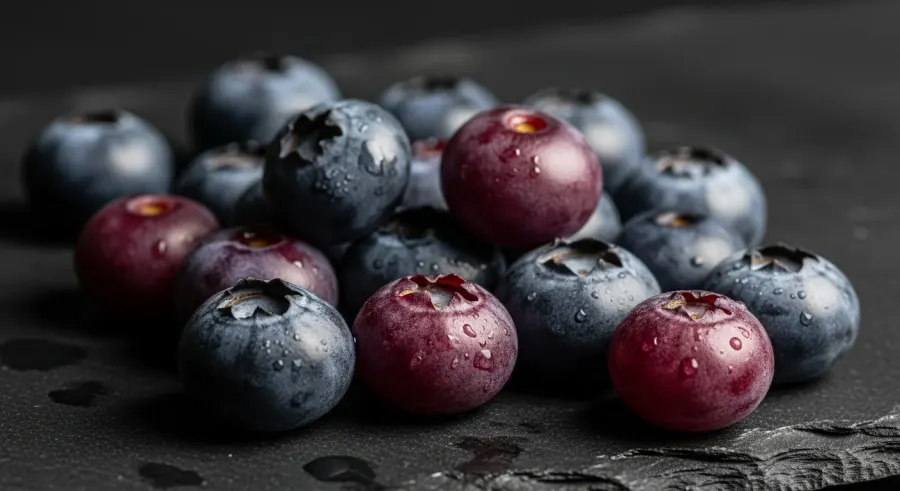
To prove this, the physicists in the study literally dissolved the powdery wax off a batch of blueberries using a solvent. Without the powder, the berries looked completely dark and almost black. The researchers then took the extracted wax, recrystallized it onto a piece of black cardboard, and watched as the cardboard suddenly turned a bright, reflective blue [1.1.1]. The white dust isn't just sitting on the fruit. It is the only reason the fruit looks blue in the first place.
What Exactly Is That Dust?
Botanists call this substance epicuticular wax. In agricultural circles, it is more commonly known simply as the "bloom."
It is not dirt, and it is not a residue that blew in from a nearby field. The blueberry plant manufactures this wax internally and pushes it out through the pores of the skin as the fruit develops. As the wax hits the outside air, it self-assembles into microscopic tubes and tiny rings, building a layered shield around the soft flesh of the berry.
According to a 2017 study in the journal Food Chemistry, researchers placed nine different cultivars of blueberries under a scanning electron microscope and analyzed their chemical makeup using gas chromatography. They found that this powdery armor is heavily composed of triterpenoids (specifically ursolic acid) and complex chemical compounds called beta-diketones.
If those sound like intimidating industrial chemicals, they are entirely natural and completely harmless to humans. They pass right through our digestive system. If you look at the USDA FoodData Central database, a 100-gram serving of raw blueberries provides roughly 57 calories and 14.5 grams of carbohydrates. The epicuticular wax contributes effectively zero calories to that total. It is simply an inert, edible raincoat designed by evolution to protect the berry from the elements.
The Pesticide Rumor Needs to Die
A strange assumption circulates in grocery store aisles. Many people see that cloudy, matte film and immediately assume it is chemical fallout. They think it's pesticide residue, fungicide spray, or some kind of industrial preservative meant to extend shelf life.
The reality is the exact opposite. A thick, highly visible coating of white powder is the ultimate sign of minimal human interference.
Because the bloom is made of delicate, microscopic wax crystals, it is highly sensitive to friction. Every time a blueberry is touched—by a human hand, a mechanical harvesting machine, or a sorting conveyor belt—some of that wax rubs off. Chemical washes and synthetic sprays used in some large-scale agricultural operations also degrade this natural coating, stripping the berry of its matte finish and leaving it looking dark and shiny.
This is why organically grown blueberries, or those purchased directly from a local farmer's market, often have a much heavier white powder coating than conventional ones shipped across the country. The organic farmers rely on gentle handling rather than chemical baths to get the fruit to market intact. When you see a pint of pale, chalky berries, you aren't looking at a chemical bath. You are looking at a batch of fruit that has barely been touched since it left the bush.
How to Spot Actual Mold
Because the epicuticular wax looks like a hazy dust, it frequently triggers false alarms. It is not uncommon for someone to toss a perfectly good pint of berries into the compost bin because they mistake the heavy bloom for fungal growth.
Telling the difference takes only a moment of observation.
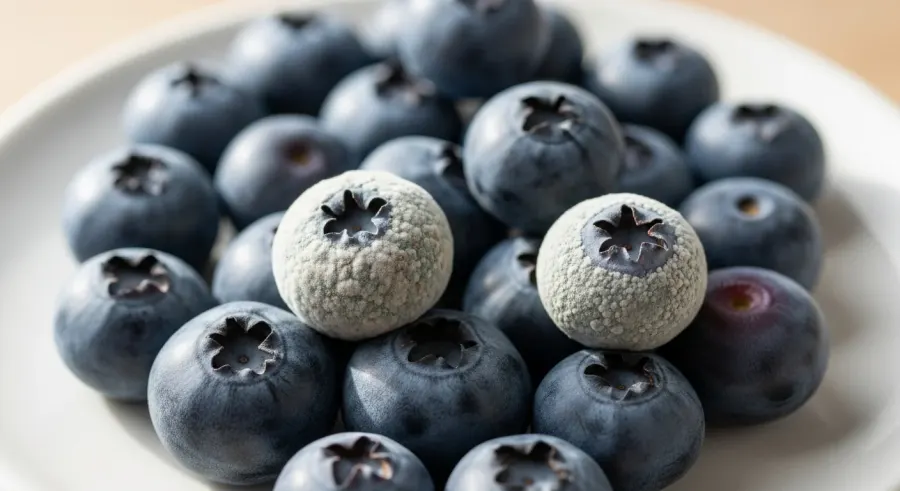
The natural bloom is an even, uniform haze that covers the entire smooth surface of the berry. If you lightly run your thumb over it, it feels completely dry, and the white color instantly wipes away, revealing a dark, shiny skin underneath.
Mold operates entirely differently. Fungal growth is localized and uneven. It usually starts at the weakest point of the fruit—often the tiny scar where the berry was attached to the stem, or where a neighboring berry split open and leaked juice. Mold will look fuzzy or stringy, building up in three-dimensional patches. It also thrives in moisture, so moldy berries will typically feel soft, wet, or sticky to the touch.
The irony is that the bloom people mistake for mold is the very thing preventing mold from taking hold. The wax is intensely hydrophobic. It causes morning dew and rain to bead up and roll right off the fruit, denying fungal spores the standing water they need to germinate.
A Secret Message for Birds
Producing true blue pigment requires a massive amount of metabolic energy. Very few plants on earth actually do it. So if a plant wants to stand out in a green forest, it has to find a cheaper way to get noticed.
The blueberry's evolutionary target audience isn't humans. It is foraging birds. And birds see the world very differently than we do. Avian vision is tetrachromatic, meaning birds have a fourth type of color receptor in their eyes that allows them to perceive ultraviolet light.
When the 2024 University of Bristol team analyzed the blueberry's wax nanostructures, they found that the crystals don't just bounce back the blue light that humans can see. They are highly tuned to reflect UV light. To a bird flying overhead, the green leaves of the bush absorb UV light and appear dark, while the wax-coated berries act like glowing, high-contrast neon signs.
This structural color is a brilliant evolutionary bargain. The plant uses cheap, easy-to-produce waxes to create a brilliant UV beacon. The birds see the glowing fruit, eat it, and fly away to scatter the seeds across the landscape, ensuring the next generation of blueberry bushes can grow.
The Grape and Plum Connection
Blueberries are not the only fruit walking around in a wax disguise. If you know what to look for, you will start seeing this exact same powdery bloom all over the produce section.
Plums frequently sport a thick, silvery coating that rubs off when you polish them on your shirt. Juniper berries use the identical nanostructure trick to achieve their pale blue hue. But the most famous example is the grape.
The bloom on grapes serves the exact same moisture-retaining function as it does on blueberries, but it has played an unexpected role in human history. The microscopic texture of the wax creates a perfect landing pad for wild, airborne yeasts in the environment. For thousands of years, long before scientists could isolate commercial yeast strains in a laboratory, winemakers relied on the wild yeast clinging to this white powder to kickstart the fermentation of their crushed grapes.
While we don't make wine out of blueberries very often, the physics and biology of their skin remain exactly the same.
The Problem With Pre-Washing
Water is the enemy of stored fruit. Yet, the first thing many of us do after unpacking groceries is dump our berries into a colander and scrub them clean under the faucet.
Once you wash that white powder down the drain, you strip the berry of its primary defense mechanism. Without the hydrophobic wax, the porous skin of the blueberry is exposed directly to the air. The internal moisture of the fruit begins to evaporate at a highly accelerated rate. The firm, taut skin quickly becomes wrinkled and deflated.
Worse, moving those stripped berries into the refrigerator guarantees condensation will form on the unprotected skin. Without the bloom to repel it, that moisture sits on the surface of the fruit, creating the exact damp environment that mold spores love. A pint of washed blueberries will frequently turn into a sad, mushy puddle in a matter of days.
The best storage strategy is benign neglect. Leave the wax exactly where it is. Keep the berries dry and cold in their original ventilated container, and only run them under water in the exact moments before you plan to eat them.
Bottom Line
The next time you see a pint of pale, dusty berries at the market, you are looking at a quiet masterclass in plant engineering. That simple film is an optical illusion designed for avian eyes, a waterproof shield built by evolution, and a clear indicator that the fruit was treated with care. You can just enjoy them knowing that the cloudy powder was exactly what kept them fresh all the way from the field to your kitchen.