In Short
The squeak comes from acoustic friction between your tooth enamel and the bean's tense, moisture-rich cellular structure. How to silence them (and why eating too many raw ones can actually trigger a plant defense mechanism) is below.
We treat them like the most mundane vegetable on the holiday table. They show up in heavy casseroles, get dumped from tin cans, and occasionally get steamed into a bright green side dish. Yet behind that quiet reputation is a plant with a surprisingly aggressive chemical defense mechanism and a fascinating physical structure.
Wait, What Causes That Noise?
It happens right as your molars come down. A distinct, slightly rubbery squeak that echoes in your skull, making some people shiver and others feel reassured.
That noise is entirely mechanical. According to food science principles regarding cellular turgor, a fresh green bean is packed with moisture. Data from the USDA FoodData Central confirms that raw green beans are mostly water—specifically, 90.3 grams of water per 100 grams of bean. When you blanch or steam a fresh bean, you soften the interior. However, the outer skin, which is rich in cellulose and pectin, remains highly elastic and taut.
As you bite down, this tense, wet, rubbery surface drags against the smooth enamel of your teeth.
The moisture creates a temporary seal. As your jaw moves, the physical drag creates acoustic friction. It is the exact same physics that makes fresh cheese curds squeak against your teeth at a dairy farm. The sound is actually an auditory indicator of freshness and proper cooking technique, proving the cell walls haven't completely collapsed.
If the sound bothers you, the fix is simple lubrication. Tossing steamed beans in olive oil or melted butter breaks the friction coefficient between the plant's skin and your enamel. Alternatively, overcooking them breaks down the pectin structure entirely. That silences the bean, but leaves you with a mushy side dish.
The Poison Hiding in the Pod
There is a lingering myth that a green bean is just a harmless garden vegetable you can pluck from the vine and eat raw by the handful.
Doing this in small amounts is usually fine. Doing it in large amounts might leave you doubled over in stomach pain.
Plants cannot run away from predators. Instead, they rely on chemical warfare to protect their offspring from being eaten before they can germinate. Legumes protect their seeds using a specific lectin (a type of sugar-binding protein) called phytohaemagglutinin, or PHA. When consumed raw, PHA survives the human digestive tract, binds to the intestinal wall, and interferes with cellular metabolism. It actually causes mammalian red blood cells to clump together. The biological result is rapid, intense gastrointestinal distress.
Red kidney beans are famous for this trait. Eating just five undercooked red kidney beans can trigger severe poisoning. What most people do not realize is that green beans contain the exact same toxin.
A report by the Centre for Food Safety confirms that raw green beans carry a significantly lower concentration of PHA than raw red kidney beans. It is a much smaller dose, but the chemical is undeniably present. This is why older recipes always insist on boiling the beans. Sustained heat (boiling for at least ten minutes) denatures the lectin. The toxic protein unfolds and becomes entirely safe to digest.
The Botanical Identity Crisis
If you browse a typical seed catalog, you will see green beans, black beans, pinto beans, and navy beans categorized as entirely different crops.
Botanically speaking, this is an illusion.
All of those beans are the exact same species: Phaseolus vulgaris. The only difference between the crisp green vegetable on your plate and the dark, dry kidney bean in a bowl of chili is the harvest time. We have simply selectively bred certain varieties to have thicker, fleshier pods.
When we eat a green bean, we are essentially eating the unripe fruit of the plant.
We consume the protective pod before the seeds inside have fully developed, swollen, and hardened. If you left that exact same green pod on the vine for a few more months to dry out in the sun, the pod would turn brittle and brown. You would crack it open to find a standard dry bean.
This early harvest is also why the nutritional profile looks more like a leafy green than a hearty legume. While a dry kidney bean is dense with mature carbohydrates and protein, the unripe pod is mostly water and fiber. According to the USDA, 100 grams of raw green beans contains a mere 31 calories and 1.8 grams of protein. You are eating the packaging, not the prize.
The Man Who Fixed the String
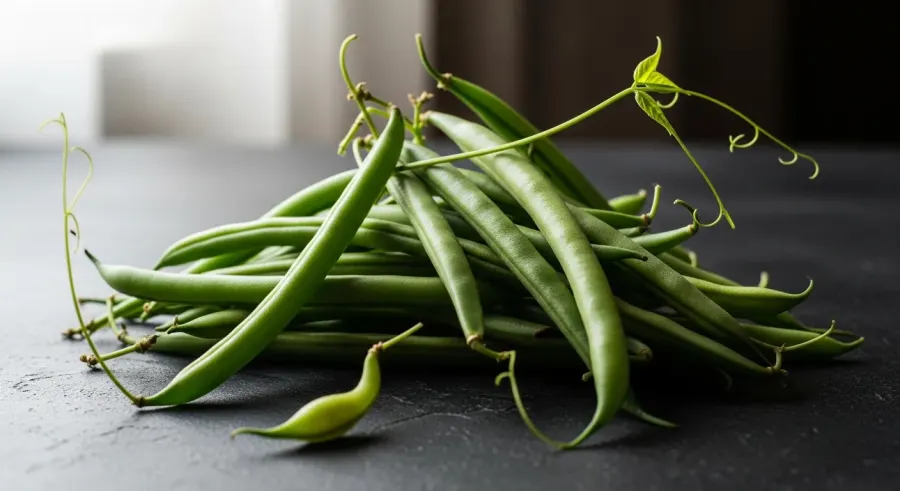
Older generations still refer to them exclusively as "string beans." Many younger cooks assume this is just a visual metaphor because the vegetables are long, thin, and stringy in appearance.
It is not a metaphor.
For thousands of years, the pod of Phaseolus vulgaris featured a tough, highly fibrous seam running down the entire length of the curve. It felt like a thick piece of sewing thread. If you did not manually zip it off before cooking, it would remain tough and fibrous, frequently getting caught in the throat. Sitting on the porch snapping and stringing beans was a mandatory, labor-intensive household chore.
The modern green bean was engineered to stop this.
In the late 19th century, a horticulturist in Le Roy, New York, named Calvin Keeney set out to fix the crop. He spent years walking through commercial bean fields, manually inspecting plants to identify rare genetic mutants that lacked the tough fibrous string. He cross-bred those specific plants over multiple generations. In 1894, he successfully introduced Burpee's Stringless Green Pod to the agricultural market.
Keeney is still revered in agricultural history as the father of the stringless bean. Because of his obsessive selective breeding, the manual chore of "stringing" beans has largely vanished from the modern kitchen, save for a few heritage varieties.
Why They Turn That Weird Color
If you have ever eaten a green bean casserole using canned vegetables, you have likely noticed their muted, olive-brown shade. There is a persistent misconception that canned beans look this way because they are old, rotting, or improperly preserved.
The reality comes down to the delicate molecular structure of plant pigment.
Fresh green beans get their vibrant color from chlorophyll. At the very center of a chlorophyll molecule sits a single magnesium atom. When you apply heat to green beans, the thermal energy damages the plant's cell walls. This damage releases natural organic acids into the surrounding water.
If those acids are trapped in the environment—either by a heavy lid on a boiling pot, or by being sealed inside a tin can during the commercial canning process—the pH of the water drops. According to food chemistry studies on pigment degradation, this highly acidic environment forces the magnesium atom to separate from the center of the chlorophyll ring. Hydrogen ions swoop in to take its place.
The moment that magnesium is lost, the chlorophyll chemically transforms into a new compound called pheophytin.
Pheophytin is functionally identical to chlorophyll in almost every way, except for how it absorbs light. It reflects a dull, drab olive-green color instead of a bright, vibrant one. The beans are perfectly safe, sterile, and nutritious to eat. They have just undergone a microscopic chemical swap. (This is exactly why professional chefs blanch green beans in massive pots of boiling water without a lid—the sheer volume of water dilutes the acid, and the open air allows the volatile acids to escape, protecting the magnesium atom).
Bottom Line
It changes how you look at a simple side dish. You are not just eating a generic vegetable; you are eating an unripe, engineered fruit, halted mid-growth, right before its chemical defenses fully mature.