In Short
A white strawberry is either in its natural mid-stage of growth, suffering from environmental sunscald, or is a genetically distinct Pineberry. Why leaving a pale berry on your counter is a terrible idea (and how to spot a fungal infection masquerading as a white fruit) is below.
We expect our strawberries to be bright red. So when a ghostly white berry shows up in a carton, or you spot a pale patch in your garden, it feels like a botanical mistake. The truth behind that missing pigment is much more interesting, involving everything from a plant's built-in enzymatic timers to extreme sunburns.
The Fifty Percent Milestone
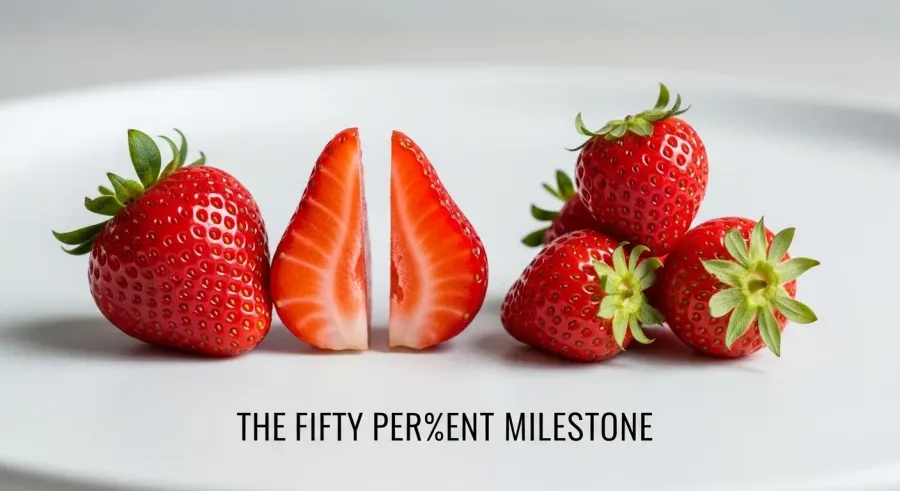
A strawberry does not magically turn red overnight. When the flower petals drop, you are left with a tiny, hard green node. As it grows, there is a distinct, pale middle phase that botanists simply call the white stage.
When a berry reaches its mature size, its physical expansion slows down, and the plant starts preparing for the final ripening phase. To understand why do strawberries turn white at this exact moment, you have to look at the genetic machinery inside the fruit shifting gears. The genes responsible for producing flavonoids and anthocyanins—the organic compounds that give plants their red, purple, and blue hues—are just starting to wake up.
Research on strawberry genetics shows that key structural genes like FaCHS and FaCHI are heavily regulated during this white transition. It is a waiting game. The berry is gathering the enzymes it needs to flood its flesh with pelargonidin, the primary pigment that makes a mature strawberry red.
During this white phase, the hormone levels in the fruit are also fluctuating. Studies on strawberry development show that levels of auxin—a plant hormone that promotes cell growth—are high when the berry is green. As the berry turns white, auxin levels drop off. This drop is the chemical signal that tells the berry to stop growing larger and start accumulating sugars and colors. If you interrupt this process and pick the berry while it is still white, that entire enzymatic cascade stops. You are holding a fruit that is structurally complete but chemically unfinished.
The Counter-Ripening Illusion
There is an old piece of kitchen wisdom that says if you leave a strawberry with a white top on the counter, it will eventually sweeten up in the sun. That is mostly an optical illusion.
To understand why, you have to look at how different fruits harvest energy. Fruits generally fall into two categories: climacteric and non-climacteric. Climacteric fruits, like bananas, tomatoes, and apples, experience a massive spike in respiration and ethylene gas production after they are picked. They contain enough stored starches to convert into sugars all on their own. You can pick a hard, green tomato, put it in a paper bag, and eat a sweet red tomato a week later.
Strawberries are non-climacteric. They do not store large amounts of reserve starches. They rely entirely on a constant, active pipeline of sucrose being pumped directly from the mother plant's leaves into the fruit. Once you cut the stem, that sugar pipeline is permanently closed.
But there is a visual trick at play. Research on post-harvest fruit development shows that strawberries can sometimes continue to synthesize anthocyanin pigments off the vine. If you pick a berry that is halfway through its white stage and leave it at room temperature, the residual enzymes inside the skin might still convert some precursor molecules into red pigment.
The white tip might actually turn a faint pinkish-red after two days in your kitchen. It looks riper to the human eye. But the sweetness, the acidity, and the nutritional profile are entirely frozen in time from the moment it left the plant. You are essentially eating a tart, watery berry wearing a red disguise.
When the Sun Bleaches the Skin
Sometimes environmental stress strips the color right out of a fully formed fruit.
If you grow your own berries, or if you frequent local farmers' markets, you have probably seen a ripe red strawberry with a strange, leathery white patch near the calyx (the green leafy top). It looks like a genetic mutation or a patch of rot. In reality, it is a bad sunburn.
Plant pathologists call this condition sunscald. It happens under very specific weather conditions. Sunscald typically occurs when a prolonged period of cool, cloudy weather is suddenly followed by intense heat and high ultraviolet light. The berries develop a sudden sensitivity to the radiation, much like human skin after a long winter indoors.
The sudden barrage of UV exposure damages the superficial cells on the upward-facing side of the fruit. The radiation physically damages the cells and degrades the red anthocyanin pigments. Without those pigments, the tissue bleaches out to a pale yellow or stark white.
Because the cells are damaged, they lose their ability to retain moisture. The affected area becomes slightly sunken and feels rubbery to the touch. The rest of the berry usually tastes perfectly fine, though the scalded portion is permanently damaged and can become an easy entry point for secondary rot if left in the field too long.
The Powdery Fungal Imposter
What looks like a white strawberry is occasionally a red one hiding under a blanket.
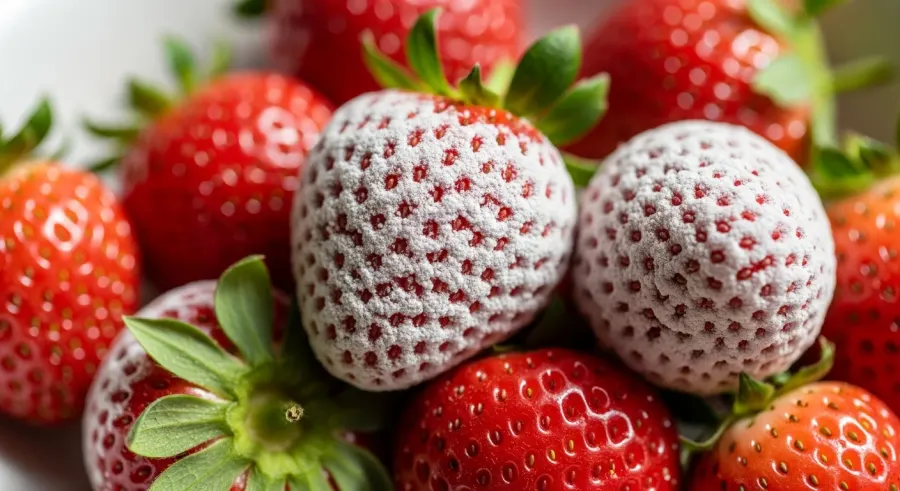
If you notice a delicate, fuzzy white coating on the fruit, you are looking at Podosphaera aphanis. This is the specific fungal pathogen responsible for powdery mildew in strawberries. It is a highly specialized organism that has evolved to exploit the unique microclimate of a strawberry patch.
The University of California Statewide Integrated Pest Management Program notes that this fungus thrives in a very strange environment: it requires high humidity, but it absolutely needs dry leaf surfaces to germinate. If it actually rains, the water washes the spores away and suppresses the infection. But in a humid greenhouse or a dense, shaded garden bed, the fungus flourishes.
The fungus does not just sit on the surface. It anchors tiny root-like structures called haustoria directly into the plant's epidermal cells. Through these haustoria, it constantly siphons off water and nutrients that the plant was trying to send to the fruit.
An infection typically starts on the undersides of the mature leaves, causing them to curl upward in a distinct, cup-like shape. From there, the airborne spores drift onto the flowers and the developing berries. A severe infection will coat the entire strawberry in a dense white mycelial web. This physical barrier blocks sunlight, halts the fruit's growth, and eventually leaves the berry completely desiccated with its seeds sharply raised above the shriveled skin.
The Genetic Ghost of the Pineberry
Then there are the berries that are supposed to look like ghosts.
Pineberries are a unique variety of strawberry that naturally have creamy white flesh and striking red seeds. When they first appeared in specialty grocery stores, a lot of consumers assumed they were either severely underripe or the product of laboratory genetic modification. Neither is true.
They are the result of traditional, albeit highly specific, selective breeding. Their genetic lineage traces back to the South American Fragaria chiloensis, a wild white strawberry native to Chile, which was crossed with the North American Fragaria virginiana. The modern commercial versions you see today, such as the patented Florida Pearl cultivar, are the culmination of years of natural cross-pollination to create a berry that thrives in warmer climates but retains that ghostly appearance.
The science behind their lack of color comes down to a missing chemical handoff. Pineberries lack the active enzyme pathways required to express pelargonidin in their flesh. The pigment is simply never manufactured. However, the genetic instruction for anthocyanin remains active in the seeds. As the berry matures, the seeds turn a vivid red, creating a sharp contrast against the pale skin.
Because they lack deep red pigments, their chemical makeup shifts in other directions. They have very low anthocyanin levels, but they make up for it with higher concentrations of other phenolic compounds like quercetin and gallic acid. The absence of the typical red strawberry chemistry also allows other aromatic compounds to shine through. Pineberries carry a distinct ester profile that gives them a prominent, tropical aroma. When you bite into one, your brain expects the tartness of an unripe berry, but you are met with a complex flavor that leans heavily toward pineapple and apricot.
The Mystery of Uneven Ripening
Sometimes a strawberry just refuses to finish the job.
You will occasionally see a large, juicy berry that is a deep, gorgeous red at the tip but features a hard, stark white ring around the stem. This is not simply a matter of being picked a day early. It is a physiological condition known as uneven ripening disorder.
While the exact trigger is still debated among horticulturists, it is closely tied to nitrogen management and temperature fluctuations during the critical white stage of development. If a strawberry plant is given too much heavy nitrogen fertilizer right as the berries are starting to color up, the plant gets confused. It diverts its energy away from fruit maturation and back into growing more leaves.
The result is a berry where the pigment distribution is physically bottlenecked. A 2025 study in the International Journal of Fruit Science analyzing uneven ripening disorder found that the dark red portions of these affected berries had significantly higher anthocyanin concentrations than the white, hardened shoulders on the exact same fruit.
The white sections are not just lacking color; they are fundamentally different in texture. They have a higher density of unsoftened pectin and significantly lower soluble sugar levels. No matter how long you leave that berry on the plant, that white ring will never turn red. The biological window for pigment synthesis in that specific band of tissue has permanently closed.
Bottom Line
The color of a strawberry tells a quiet story about its history. A white hue can mean it was picked a few days too early, caught in a harsh burst of sunlight, or bred specifically for a tropical flavor. Watching that pigment develop—or fail to—is just a visible record of the plant's environment and genetics.