In Short
Basil leaves turn black due to cold-induced cellular collapse and a defense enzyme that oxidizes when exposed to air. Why tearing the leaves actually makes this browning worse (and how a pot of boiling water fixes it) is below.
You bring home a perfect, vibrant bunch of sweet basil, put it away, and by the next afternoon it looks like wet tea leaves. The rapid darkening feels like a failure of food storage, but it is actually a complex biological reaction playing out right on your cutting board. The plant is simply responding to its environment.
The 54-Degree Death Zone
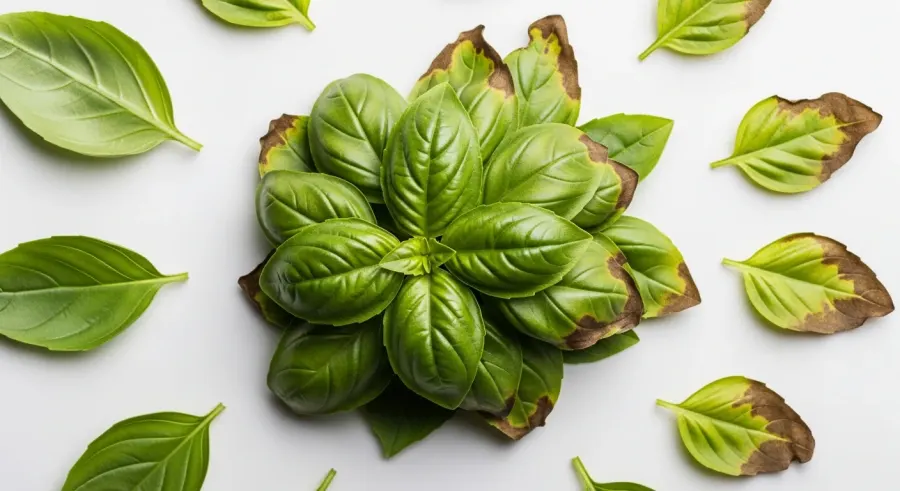
I used to bring home a gorgeous bouquet of sweet basil and put it right into the crisper drawer. It seemed like the logical thing to do with fresh greens, especially since lettuce and spinach thrive in that cold, humid environment. The next morning, the basil leaves would invariably look dark and wilted, with black patches spreading rapidly from the edges inward.
The problem comes down to the plant's ancestral DNA. Basil is a tropical and subtropical plant, originally native to regions in Central Africa and Southeast Asia. It evolved to thrive in hot, humid environments, bathing in full sun. Consequently, it never developed the cellular defense mechanisms required to survive cold weather. Temperate winter crops like kale or cabbage can handle a frost because their cells adapt to the cold, but basil entirely lacks this biological programming.
When basil is exposed to temperatures below 54°F, it undergoes a severe physiological stress known as chilling injury. According to greenhouse guidelines from UMass Amherst (2021) and e-GRO, chilling injury is entirely different from freezing injury. The water inside the plant isn't turning to ice and expanding. Instead, the prolonged cold exposure disrupts the lipid bilayer of the cell membranes. The fats in the membrane solidify, causing the cell walls to lose their structural integrity and begin leaking fluids.
This microscopic leakage is what you are seeing when the leaves turn limp and black in your refrigerator. The cells are essentially collapsing in on themselves. The damage is irreversible, and the process accelerates the moment you take the cold-shocked basil back out into room-temperature air. A standard home refrigerator typically hovers around 37°F, which makes it a highly hostile environment for a tropical herb. Supermarkets often make the same mistake, placing fresh basil in refrigerated display cases where the chilling injury begins before you even place it in your shopping cart.
The Defense Enzyme Inside the Leaves
The dark edges on bruised basil aren't actually a sign of the plant rotting. They are evidence of the plant fighting back against a perceived threat.
In the wild, when a caterpillar takes a bite out of a basil leaf, the plant wants to make itself as unappetizing as possible. To do this, it relies on a built-in chemical weapon called polyphenol oxidase (PPO). This is the exact same enzyme responsible for turning sliced apples, potatoes, and avocados brown when they sit out on the kitchen counter.
Under normal circumstances, PPO and the plant's phenolic compounds are kept safely separated in entirely different compartments of the plant cell. But when the cell is ruptured—whether by an insect's jaw or a chef's knife—the internal walls break open. The PPO mixes with the phenolic compounds and, crucially, with oxygen from the air. This combination triggers a rapid oxidation reaction.
Research published in the UF Journal of Undergraduate Research (2020) focused on cloning the DNA sequences of these PPO genes in sweet basil to better understand the browning reaction. The enzyme catalyzes the oxidation of phenolic compounds into highly reactive molecules called quinones. These quinones then bind together to form complex, dark polymers known as melanin. Yes, it is the same melanin pigment that determines skin and hair color in humans.
In basil, the concentration of these phenolic compounds is so high that the resulting melanin looks pitch black rather than light brown. Furthermore, this reaction serves a brilliant evolutionary purpose. According to a 2022 review in Encyclopedia.pub, the quinones produced by PPO actually bind to the plant's proteins. This binding severely reduces the plant's protein digestibility and overall nutritional value for herbivores. The basil is literally turning itself into a low-value meal to convince the pest to go eat something else.
Tearing vs Chopping: A Cellular View
Someone probably told you once that you should always tear basil leaves by hand because metal knives make the edges turn dark. It is one of the most stubborn pieces of culinary folklore out there, and from a biological perspective, it is entirely backwards.
The idea likely stems from the fact that old carbon steel knives, which were common decades ago, could chemically react with the acidic components in certain vegetables. But with modern stainless steel chef's knives, the metal itself isn't causing any chemical reaction with the basil. The browning is a purely mechanical issue driven by how much cellular damage is inflicted on the leaves.
If we look at a basil leaf on a microscopic level, we see a rigid grid of cell walls made of cellulose, each holding a large, water-filled vacuole. When you slice through a leaf with a razor-sharp knife, the ultra-thin edge shears through a single, microscopic line of cells. Only the cells directly in the exact path of the blade are ruptured. The cells immediately adjacent to the cut remain intact, meaning their polyphenol oxidase stays safely locked inside.
Tearing the leaf does the exact opposite. Fingers do not have a sharp edge. When you pull a leaf apart, you are stretching, bending, and crushing the plant tissue until it finally gives way along a jagged, irregular fault line. This blunt force trauma damages a massive swath of cells across a wide area. More ruptured cells mean more PPO is released, which means more oxygen interacts with the enzymes, leading to rapid and widespread blackening.
The same physics apply to dull kitchen knives. A dull blade doesn't cleanly cut; it crushes its way through the leaf, applying pressure until the cell walls burst outward, mimicking the extensive damage of tearing. If you want your basil to stay green on the cutting board, the best tool is simply the sharpest blade you own.
Why Pesto Turns Swampy (And The Fix)
Throwing a handful of fresh leaves into a food processor creates a worst-case scenario for enzymatic browning. The spinning metal blade acts less like a precision slicer and more like a club, obliterating nearly every single cell in the plant. This releases a massive flood of PPO while the vortex of the machine aggressively whips oxygen into the mixture.
This is why homemade pesto often turns into a dark, muddy green sludge within minutes of being blended. The flavor might still be acceptable, but visually, it loses that vibrant, appetizing appeal. Professional kitchens avoid this swampy aesthetic by exploiting a simple physical weakness in the polyphenol oxidase enzyme: it cannot survive high heat.
Enzymes are complex proteins folded into very specific three-dimensional shapes. Just like the clear white of an egg turns solid and opaque when it hits a hot skillet, the molecular structure of an enzyme warps and permanently changes shape when exposed to boiling water. This process is known as denaturation. Once the PPO enzyme loses its specific physical shape, it can no longer catalyze the reaction between phenolics and oxygen. The browning mechanism is permanently broken.
To achieve this without cooking the basil and ruining its fresh flavor, chefs use a technique called blanching. Dropping the basil leaves into a large pot of rapidly boiling water for a few seconds is just enough time to denature the enzymes on the surface and within the thin leaves. You then immediately plunge the leaves into a bowl of ice water to stop the cooking process cold. The result is basil that will stay a striking, neon green even after being totally pulverized in a blender.
The Flavor Evaporation Problem
You might be wondering if those darkened, wilted leaves are still safe to eat. They are completely harmless from a food safety perspective. But biologically speaking, a blackened basil leaf has lost the very thing that makes it worth eating in the first place.
The signature aroma of basil—that warm, spicy scent with distinct notes of clove and cinnamon—is driven primarily by a volatile organic compound called eugenol. It is a highly aromatic oil trapped within the intact cells of the plant. (For context on how strong this compound is, clove essential oil is made up of nearly 90% eugenol).
In 2007, researchers at the Salk Institute for Biological Studies mapped the three-dimensional structure of basil's eugenol synthase, the specific enzyme responsible for creating this aromatic compound. They discovered something fascinating about the plant's internal chemistry. The enzyme takes a basic molecular building block that plants typically use to create hard, rigid wood, and chemically alters it into the complete opposite: a highly volatile molecule that easily becomes airborne.
That intense volatility is a double-edged sword. It is the reason you can smell a fresh basil plant from across the garden, but it also means the compound escapes rapidly when the plant's physical defenses fail. When chilling injury or physical crushing causes the cell walls to collapse, the eugenol is exposed to the air and evaporates. By the time the leaf has turned completely black, the vast majority of its aromatic oils have vanished into the atmosphere. You are left with a degraded plant tissue that tastes faintly of wet grass.
The Oxygen Barrier Paradox
Since ambient oxygen is a required ingredient for the browning reaction, blocking it out entirely seems like a logical workaround for the kitchen. If the PPO enzyme cannot access oxygen, it cannot create the dark melanin pigments, regardless of how badly the plant cells are damaged.
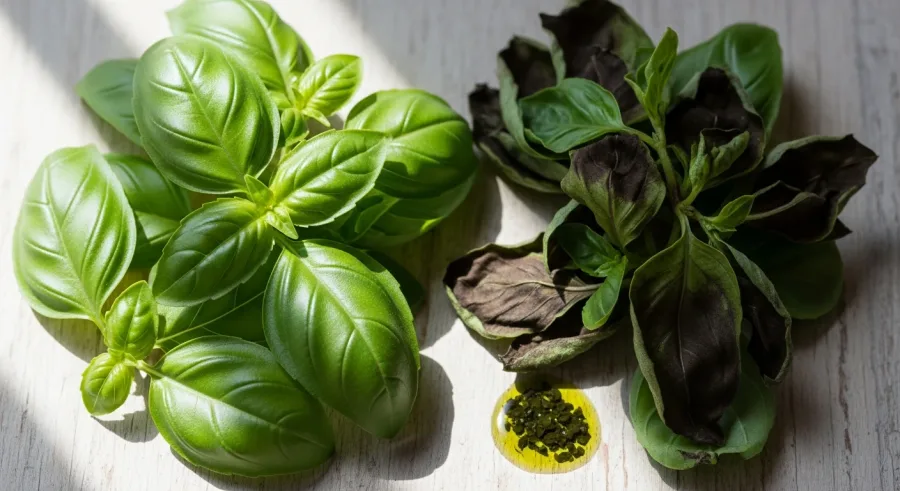
This is why chopped basil submerged completely in a layer of olive oil will retain its green color for much longer than basil left exposed on a cutting board. Water contains dissolved oxygen and offers little protection, but oil creates a thick lipid seal that acts as a physical barrier against the air. It is a common practice in restaurants to prep basil for evening service by immediately coating the chiffonade (thinly sliced ribbons) in a light layer of oil.
However, trying to use this trick for long-term storage introduces a serious biological paradox. Anaerobic environments—those totally devoid of oxygen—are the exact conditions where Clostridium botulinum bacteria thrive. While coating fresh basil in oil is a great short-term trick for a dinner party, storing raw herbs in oil at room temperature for days is a known food safety risk.
The usual advice for safely storing garlic or herbs in oil is to keep the mixture in the refrigerator. But as we established earlier, putting basil in a 37°F refrigerator triggers chilling injury, causing the cell walls to collapse and turn black anyway. You are trapped between bacterial risk on the counter and cellular collapse in the fridge. Because of this paradox, the oil barrier works best as an immediate, temporary shield. It pauses the enzymatic browning just long enough to get the vibrant green herb from the cutting board to the dinner plate.
Bottom Line
A bunch of basil is a fragile collection of chemical reactions waiting to happen. The plant is built for hot weather and relies on complex enzymes to defend itself when damaged. Treating the herb gently, keeping it out of the cold, and using a very sharp blade are small adjustments that respect the cellular structure of the leaves.