In Short
The soap flavor isn't an illusion—it is caused by a genetic variant that makes you hyper-sensitive to the specific aldehyde chemicals found in both cilantro and actual soap. How this genetic glitch works (and the scientific kitchen trick to bypass it) is below.
You take a bite of a perfectly good taco, and suddenly it tastes like someone pumped dish detergent into your mouth. For years, people who despise this herb were told they were just being picky eaters. The reality is far stranger, rooted deep in human DNA and the survival mechanisms of plants.
Wait, Is It Actually Soap?
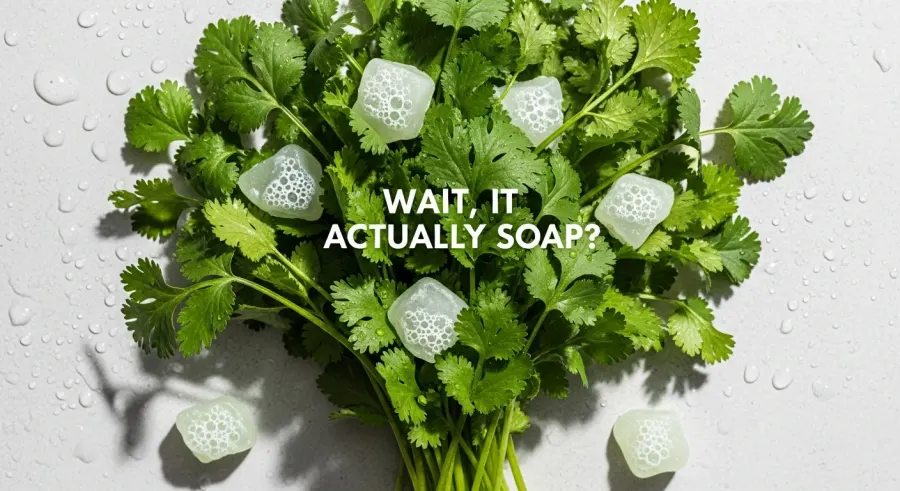
Biting into a fresh sprig of cilantro and tasting Dawn dish soap feels like a glitch in the matrix. You look around, and everyone else is happily chewing away, calling the flavor bright or citrusy. It turns out the soapy sensation is not a dramatic metaphor. You are tasting the exact same chemical compounds found in a bar of soap.
The signature aroma of cilantro comes from organic compounds called aldehydes. Specifically, the leaves are packed with one called trans-2-decenal. If that sounds like a chemical you’d read on the back of an industrial cleaning product, you are exactly right. When soap is manufactured through the traditional rendering of fats—a process involving alkaline lye—various aldehydes are created as a chemical byproduct. They possess a distinct, pungent, slightly waxy smell that immediately registers to the human brain as a cleaning agent.
This division is not a modern phenomenon. The disagreement over whether the herb is delicious or disgusting stretches back centuries. In the first century, the Roman naturalist Pliny the Elder praised its cooling properties. But jump forward to the sixteenth century, and the famous herbalist John Gerard described it as a stinking herb with venomous quality. Around the same time, the French agriculturist Olivier de Serres claimed it smelled exactly like crushed insects. They were all describing the exact same plant, but their biology was feeding them entirely different sensory realities. If you have the genetic hardware to detect these specific compounds, eating cilantro is chemically indistinguishable from chewing on a bar of Ivory soap. Your brain is not imagining the connection. It is correctly identifying a molecular match.
So What Is in the DNA?
In 2012, researchers published a massive study analyzing the genomes of tens of thousands of people to find the root of this culinary divide (Flavour, 2012). They were looking for the exact mechanism that causes the soap reflex, and they found the culprit sitting quietly on human chromosome 11.
It is a genetic variant near a gene known as OR6A2. This specific gene is responsible for building olfactory receptors in your nose. Taste is largely dictated by smell. When you chew food, volatile compounds travel up the back of your throat and into your nasal cavity, where they interact with these receptors. Think of olfactory receptors like biological locks, waiting for very specific chemical keys floating in the air. For people with a certain variation of the OR6A2 gene, their aldehyde lock is highly sensitive. The moment trans-2-decenal hits the receptor, it fires off a massive warning signal directly to the olfactory bulb.
People without this specific variant simply do not have the same alarm system. Their olfactory receptors ignore the soapy aldehydes and instead latch onto the other aromatic compounds in the plant. The most prominent of these is linalool, a compound heavily present in lavender and citrus fruits, which produces a pleasant, sweet, floral scent. It is a completely different sensory experience dictated by microscopic variations in DNA. One person smells lavender and lemon. The other smells a laundromat.
The Bug Spray in Your Salsa
Plants do not want to be eaten. Since they cannot run away from predators, they fight back with chemical warfare. The aldehydes in cilantro are actually a highly evolved botanical defense mechanism meant to keep pests away.
This is where the story gets slightly gross. That same aldehyde, trans-2-decenal, is famously used by several species of stink bugs. When a stink bug feels threatened or gets crushed by a predator, it secretes a potent defensive spray meant to blind and repel whatever is trying to eat it. The primary active ingredient in that noxious spray is the exact same chemical giving your guacamole its signature zing. Olivier de Serres was entirely correct in the 1500s when he compared the herb to insects.
When a person with the OR6A2 variant eats cilantro, their body is reacting exactly the way nature intended. The brain receives a chemical signal identical to an insect’s distress spray, and the amygdala—the part of the brain that processes fear and threat response—immediately translates that signal as a warning. This is why the aversion feels so visceral and automatic. Your biology is trying to protect you from what it perceives as a toxic bug secretion. The fact that someone else at the table is happily eating it just confuses your survival instincts even more.
Does Everyone Hate It Equally?
Geography plays a massive role in who gets hit with the soapy curse. The 2012 genome study revealed that the OR6A2 variant is not distributed evenly across the globe (Flavour, 2012). It clusters heavily in specific ancestral lineages, creating wide gaps in how different cultures perceive the exact same dish.
According to the data, up to 21 percent of people of East Asian descent report the soapy taste, along with 17 percent of people with European ancestry and 14 percent of those of African descent. But when researchers looked at populations from South Asia, the Middle East, and Hispanic cultures—places where the herb is a daily dietary staple—the numbers plummeted. Only 3 to 7 percent of those groups experience the soapy flavor.
This raises a fascinating chicken-and-egg question for anthropologists. Did regions with lower rates of the soap gene naturally adopt cilantro because it tasted better to them? Or did centuries of heavy dietary exposure in places like Mexico and India slowly weed out the genetic sensitivity over generations? While geneticists note that the OR6A2 variant only accounts for a portion of the overall aversion—meaning environment and upbringing play a huge role too—the correlation is too stark to ignore. If you grew up in a culture that historically avoids the herb, you are statistically far more likely to inherit the hardware that hates it.
The Harold McGee Loophole
Food science writer Harold McGee spent years investigating this phenomenon, eventually publishing a brilliant biochemical workaround in the New York Times in 2010. He had discovered a Japanese study detailing the exact breakdown of cilantro volatiles, and realized the plant contains the very tools needed to destroy its own soapiness.
The trick relies on the plant's internal cellular structure. Cilantro leaves contain specific enzymes that are ordinarily kept safely separated from the pungent aldehydes. But when you heavily damage the plant's cells by bruising, crushing, or pulverizing the leaves, you force the enzymes and aldehydes to mix. When exposed to oxygen, these enzymes immediately get to work breaking down the soapy trans-2-decenal molecules, converting them into non-aromatic substances.
This means the preparation method completely dictates the flavor. If you roughly chop a few whole leaves with a sharp knife and toss them on a taco, the aldehyde structures remain largely intact. The soap flavor will hit you at full force. But if you pulverize the leaves into a fine paste using a mortar and pestle, or blend them aggressively into a creamy green salsa, the enzymes destroy the soapiness within a few minutes. This structural loophole is why many people who claim to hate raw cilantro have absolutely no problem eating complex green curries or blended chutneys.
The Heat Trick
There is a second vulnerability in the plant's chemical armor. Aldehydes are highly volatile compounds, meaning their molecular bonds break down and evaporate rapidly when exposed to high heat.
If the mortar and pestle method sounds too tedious, thermal destruction is the next best option. Dropping chopped cilantro into a simmering soup or a hot sauté pan for a few minutes is enough to significantly reduce the OR6A2 trigger. The thermal energy evaporates the volatile aldehyde molecules. For perspective, raw cilantro is mostly water (with just 23 calories per 100g, according to the USDA, alongside a heavy dose of Vitamin K). Because it has almost no dense cellular structure to protect it from temperature changes, heat penetrates it instantly.
The trade-off here is severe. Boiling the herb destroys the soapy taste, but it also annihilates the linalool and other delicate citrusy notes that normal tasters enjoy. You are left with a mild, slightly earthy green garnish that offers almost no flavor at all. It works perfectly for hot braises, pho, or stews where you just want a pop of visual color, but it completely fails if you are trying to recreate the bright, acidic bite of a fresh pico de gallo.
Rewiring Your Own Brain
You might be wondering if this genetic quirk is a life sentence. Are you forever banned from enjoying authentic street tacos because of a microscopic variation on chromosome 11? The short answer is no.
The human brain is highly adaptable, a concept known to neuroscientists as neuroplasticity. While your genetic hardware determines how your nose detects the chemical, your brain gets to decide how it interprets that signal. Researchers have found that repeated exposure to a negative flavor in a highly positive context can actually overwrite the initial disgust response.
Think about black coffee, dry red wine, or intensely funky blue cheese. The first time you tasted them, your brain probably screamed at you to spit them out. But because you kept pairing those bitter or funky flavors with positive social settings, caffeine rushes, or rich fats, your brain eventually recategorized the threat signals as pleasant. The exact same psychological trick applies to the soap gene. By eating small amounts of crushed cilantro paired with rich roasted meats, heavy salts, and fats, many former haters have successfully trained their brains to ignore the soap alarm. The trans-2-decenal is still hitting the receptor, but the mind simply stops caring.
Bottom Line
Taste is rarely as simple as good or bad. It is a messy collision of plant botany, genetic luck, and whatever you happened to eat growing up. You might always perceive a faint soapy echo when you order a taco, but understanding the chemistry behind it takes the sting out of the bite.