In Short
Cornstarch thickens sauces because heat causes its dense carbohydrate granules to swell and absorb water, forming a gel network. But temperature, acid, and whisking can all secretly sabotage this delicate process in ways most cooks never realize.
It is one of the most reliable magic tricks in the kitchen. You pour a cloudy white liquid into a simmering pan of broth, and seconds later, it transforms into a rich, glossy glaze. We all know how to make a slurry, but what is actually happening on a molecular level is surprisingly delicate.
Wait, Why Does Hot Water Make It Clump?
We all know the golden rule of making a slurry is to use cold water. If you skip this step and dump dry cornstarch directly into simmering pan drippings, you immediately get stubborn, powdery lumps that refuse to dissolve.
It turns out this isn't because cold water is doing anything special. It is actually because hot water is doing its job entirely too fast.
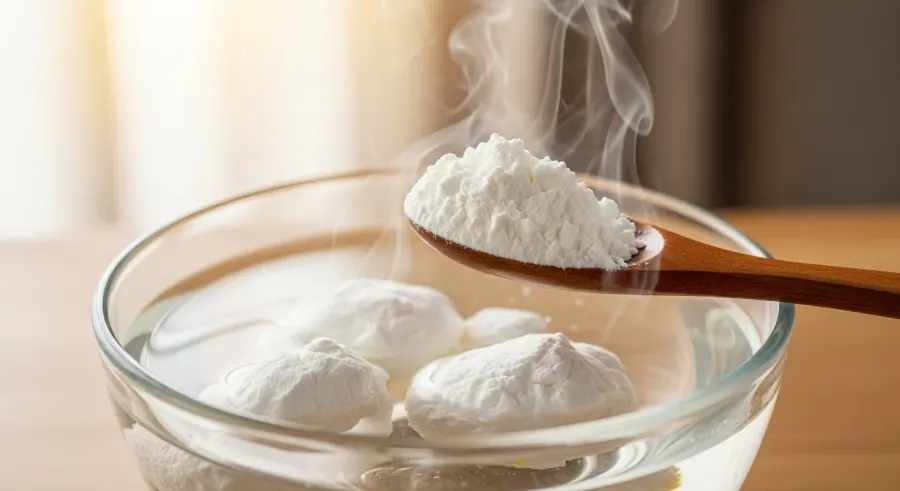
When you drop a spoonful of dry cornstarch into hot liquid, the outermost layer of the powder instantly hits its gelatinization temperature. That outside layer immediately swells and forms a waterproof, rubbery jacket around the rest of the clump. The water physically cannot penetrate the gel barrier, leaving dry powder perfectly trapped inside. If you try to smash these lumps against the side of the pan with a wooden spoon, you usually just break them into smaller, equally waterproof lumps. It becomes a frustrating game of whack-a-mole.
Mixing the powder with cold water first sidesteps the issue entirely. Cold water lacks the thermal energy required to trigger gelatinization. It simply suspends the starch particles evenly, giving them time to disperse throughout the pan before the heat locks everything into place.
The Magic Temperature Window
To understand what is actually happening in the pan, we have to look at the raw makeup of the powder. According to USDA FoodData Central, a 100g serving of cornstarch contains 381 calories and is basically pure carbohydrate—91.27g of it, to be exact, with just 0.9g of fiber, 0.26g of protein, 0.05g of total fat, and zero sugar. There is virtually no fat or protein to get in the way of the starch.
Those carbohydrates exist as tight, dense little granules containing two types of starch molecules. There is amylose, which looks like a long, straight chain, and amylopectin, which resembles a highly branched, bushy tree. At room temperature, they just sit there, tightly packed and completely inert.
But when you heat them in water, the magic happens within a very specific thermal window. Gelatinization really begins in earnest around 144°F (62°C). As the water heats up, it penetrates the granules, causing the branched amylopectin to absorb moisture and swell to several times its original size.
By the time the sauce reaches about 185°F (85°C), those bloated granules start bumping into each other. They crowd the pan, creating the physical friction that we perceive as a thick, glossy sauce. You don't need a raging boil to get there, just enough heat to coax the granules open. Regular cornstarch is usually about 25% amylose and 75% amylopectin. Because amylose is responsible for setting up into a firm gel as it cools, these sauces will thicken while hot but still firm up considerably as they drop in temperature.
Lemon Juice Chops The Molecules
Have you ever tried making a lemon meringue pie filling or a sweet-and-sour sauce, only to find that it never quite sets up? You keep simmering, you add more slurry, and it just stays stubbornly thin.
The culprit here is acidity, and it works like an invisible sabotage agent against your thickener. Ingredients like lemon juice, vinegar, or even highly acidic fruit juices trigger a chemical reaction known as acid hydrolysis.
When you simmer cornstarch in an acidic environment, the acid physically attacks the structure of the starch. Research published in Carbohydrate Polymers (2003) outlines how acid cleaves the α-1,4-glycosidic bonds that hold the starch chains together. It is essentially taking a pair of molecular scissors to your thickening agent.
Instead of long, resilient carbohydrate networks capable of trapping water, you end up with chopped up, fragmented chains that cannot hold onto anything. The longer the acid cooks with the starch, the more bonds are broken, and the thinner the sauce becomes. This is why a lemon glaze made for a pound cake behaves differently than a savory beef gravy. The gravy is largely neutral, allowing the starch network to form undisturbed.
The fix is just a matter of timing. You whisk the acid in at the very end of cooking, after the starch has already swollen and the pan is off the heat.
Whisking Harder Actually Makes It Thinner
You spot a lump in your gravy. Your first instinct is to grab a wire whisk and beat the sauce until it is smooth again.
This is a trap. Cornstarch gels behave in a way that food physicists classify as "shear-thinning." Once those starch granules have absorbed water and swollen into delicate, plump little balloons, they become surprisingly fragile. They are holding a massive amount of water relative to their size, and their structural walls are stretched thin.
Applying intense mechanical stress—like furious whisking, blending, or hitting the sauce with an immersion blender—physically tears the swollen granules apart. Studies in food rheology document how high shear forces break down aggregated starch networks. When the granule walls rupture prematurely, they dump their trapped liquid right back into the pan.
You might eliminate the lump, but you will also permanently thin out the surrounding sauce. Think of the granules like tiny water balloons. If you stir them gently, they glide past each other, creating a smooth, viscous texture. If you hit them with the sharp wires of a whisk moving at high speed, you slash the balloons. Once a sauce reaches its final temperature, a gentle stir with a wooden spoon or a silicone spatula is all it needs to distribute the heat evenly without causing structural damage.
Sugar Is A Hydration Thief
When you are making a dessert like a fruit pie filling or a sweet pudding, you might notice that the mixture takes significantly longer to thicken than a savory gravy.
This delay happens because sugar is highly hygroscopic, meaning it loves to attract and hold onto water. When you combine high amounts of sugar, water, and cornstarch in the same pot, a silent tug-of-war begins.
The sugar molecules aggressively bind to the available water. As the temperature rises and the cornstarch granules try to absorb moisture to swell, they find that the sugar has already claimed a large portion of the liquid. The starch has to work much harder to pull the water away from the sugar.
If a recipe is extremely sweet, the gelatinization process is delayed, requiring a longer cooking time and sometimes slightly higher temperatures to reach the proper consistency. It is a quiet battle for hydration happening right in the middle of your saucepan.
The Leftover Gravy Puddle
Sometimes a sauce looks flawless at dinner, coating the back of a spoon perfectly, but turns into a weeping, watery puddle when you pull it out of the fridge the next day.
This phenomenon is called syneresis, and it is all about how the starch behaves when it gets cold. Remember those linear amylose molecules we mentioned earlier? During cooking, they leach out of the granules and form a supportive net that holds the sauce together. But as the sauce cools down in the refrigerator, those straight chains try to realign and pack closely together, returning to a more stable, crystalline structure in a process called retrogradation.
As they tighten up—and especially if they are subjected to the harsh temperature drop of a freezer—they squeeze the network so tightly that the trapped water is literally wrung out like a wet sponge. The starch pulls together into a rubbery clump, leaving a pool of thin liquid behind.
You might have experienced this when looking at a leftover stir-fry. The glossy sauce from the night before has turned into a translucent, watery broth pooling at the bottom of the container, with weirdly firm clumps of starch clinging to the vegetables. Industrial food producers get around this by using chemically modified starches designed to resist retrogradation. But for the home cook using standard pantry cornstarch, the freezer is essentially a death sentence for the sauce's texture.
Why Boiling Ruins Everything
There is a common assumption in cooking that if a liquid is too thin, you just need to boil it longer to evaporate the water and reduce it. With a cornstarch-thickened sauce, doing this will completely destroy your texture.
Those swollen starch granules have a physical limit. They can only expand so much before they reach their breaking point. If you hold a thickened sauce at a rolling boil for ten or fifteen minutes, the aggressive bubbling and sustained high heat will cause the granules to over-swell and explode.
Once they pop, the structural integrity of the gel collapses entirely. The complex network that was providing that luxurious mouthfeel disintegrates. What started as a beautifully glossy glaze will turn back into a thin, starchy soup. At that point, no amount of extra simmering will bring it back, because the physical architecture of the thickener has been permanently destroyed. You would have to start over with a fresh slurry.
Bottom Line
The next time you make a pan sauce, you can look at that little bowl of cloudy water a bit differently. It is not just a thickener, but a microscopic collection of carbohydrate balloons waiting for the exact right environment to swell, hold water, and bring a dish together.