In Short
Okra isn't slimy because you cooked it wrong. The gel is an evolutionary survival tool made of complex sugars designed to hold water during severe droughts. That same mucilage helps stabilize blood sugar and is botanically identical to the sap originally used to make marshmallow candy.
You slice into a bright green pod, and immediately, your knife is trailing thick, gelatinous threads. It feels less like prepping dinner and more like a high school science experiment. But that sticky texture isn't a flaw in the vegetable, nor is it a sign of a bad cook.
The Marshmallow Connection
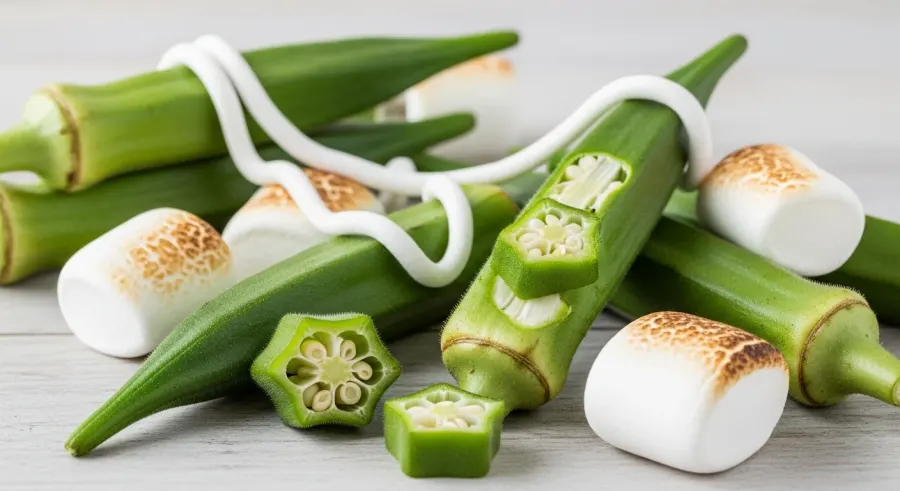
You might not think to compare a bowl of stewed okra to a campfire s'more. But botanically speaking, they share a very specific family trait. Okra (Abelmoschus esculentus) belongs to the Malvaceae family, more commonly known as the mallows.
If you have ever stopped to admire an okra blossom in the garden, you probably noticed it looks remarkably like a hibiscus flower. That is no coincidence. Hibiscus is in the same family. So is the cotton plant, and so is the cacao tree. But the most revealing relative in this lineage is a humble herb called Althaea officinalis, better known as the marsh mallow.
For thousands of years, confectioners relied on the sticky root sap of the marsh mallow plant to create a sweet, whipped treat. Ancient Egyptians originally mixed the sap with honey and nuts to soothe sore throats. By the nineteenth century, French candy makers figured out how to whip the viscous sap with egg whites, sugar, and rose water, creating the fluffy confection we recognize today. Modern commercial marshmallows are made entirely with animal gelatin and corn syrup. But the original recipe relied exclusively on the plant's natural mucilage.
That exact same mucilaginous trait runs deep in the mallow family tree. The thick, viscous liquid you see on your cutting board when you prep okra is a close chemical cousin to the botanical gel that gave the marshmallow its name. It is not a sign of a bad vegetable. It is a defining characteristic of an ancient lineage of plants that have been providing humans with medicine and food for millennia. The mallow family uses this gel to protect itself, and okra is simply the most obvious example of this trait in the modern grocery store.
Built to Survive the Desert
Plants do not waste valuable metabolic energy manufacturing complex sugars just to annoy home cooks. For the okra plant, the viscous gel is a highly engineered survival tool.
Okra likely originated in the hot, arid climates of East Africa, specifically around Ethiopia, before spreading to South Asia and the Americas. To survive long stretches without rain under intense sun, the plant had to develop a biological method to hoard water. It achieved this by producing high volumes of mucilage.
Chemically, this slime is a complex network of exopolysaccharides. It is packed with long-chain sugar molecules, specifically galactose, rhamnose, and galacturonic acid. When these molecules encounter water, they grab onto it and refuse to let go. They swell up, forming a thick, gelatinous matrix that locks moisture deep inside the plant's tissues.
A comprehensive 2024 review published in the European Polymer Journal detailed how these specific polysaccharides give okra its unique structural characteristics. During a severe drought, the mucilage acts like an internal water tower. The hotter and drier the environment becomes, the more the plant relies on this gel to keep its pods from shriveling into brittle husks.
It also protects the plant's future. The slime surrounds the immature seeds inside the pod, ensuring they have enough moisture to eventually mature and drop to the ground. Without this viscous defense mechanism, the okra plant would have gone extinct long ago in the harsh climates where it evolved. The slime isn't a defect. It is the literal reason the plant can survive the afternoon heat.
Wait, Is It Just Spoiled?
A common misconception is that excessive slime means the okra has gone bad. It is easy to see why this myth persists. In many other vegetables, a slimy exterior is the absolute first indicator of bacterial rot. If your spinach or zucchini feels sticky, it belongs in the compost bin.
But okra plays by different rules. The mucilage is a sign of cellular health, not decay. When an okra pod is fresh and deeply hydrated, its specialized cells are completely swollen with the polysaccharide gel. A freshly picked, perfectly ripe pod will actually produce more mucilage when cut than an older, slightly dehydrated pod.
If you leave okra in the refrigerator for a week, it will begin to lose moisture. The pod will look a bit limp, and the internal slime will start to dry up. Ironically, the older and more degraded the vegetable gets, the less viscous it becomes when you finally slice it. Judging okra by the same standards as a cucumber will lead you to throw away perfectly good produce. The stickiness is proof that the plant's internal water-retention system is still functioning exactly as nature intended.
Is the Slime Actually Good For You?
A persistent myth claims that the sticky texture is mildly toxic, hard to digest, or just an unpleasant side effect of cooking. The truth is quite the opposite. Your digestive system considers this gel to be highly beneficial.
Okra mucilage is a dense and efficient source of soluble fiber. According to the USDA FoodData Central, a 100-gram serving of raw okra provides 33 calories and 3.2 grams of dietary fiber, alongside a solid dose of vitamin C. A significant portion of that fiber is the mucilage itself.
Dietary fiber comes in two main forms. Insoluble fiber acts like a broom, sweeping through your digestive tract to keep things moving. Soluble fiber, on the other hand, acts like a sponge. When you consume okra slime, it travels through your stomach and binds to other substances. It actively traps excess cholesterol and bile acids. Because bile acids are made from cholesterol, carrying them out of the body forces your liver to use up more cholesterol to make new bile. This naturally lowers your overall circulating cholesterol levels.
Recent findings published in PLOS One (2026) highlighted that okra-derived oligosaccharides from this exact mucilage possess strong antidiabetic properties. The gel physically slows down the rate at which your intestines absorb carbohydrates, preventing sharp spikes in blood glucose after a meal. It even inhibits certain enzymes, like alpha-glucosidase, which are responsible for breaking down starches. You might dislike the texture on your fork, but your metabolic system responds to it perfectly.
Why the Knife Makes It Worse
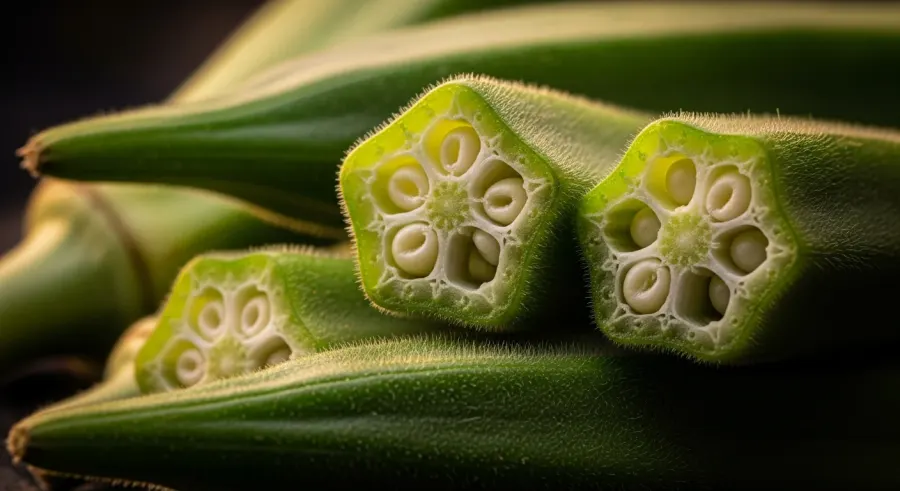
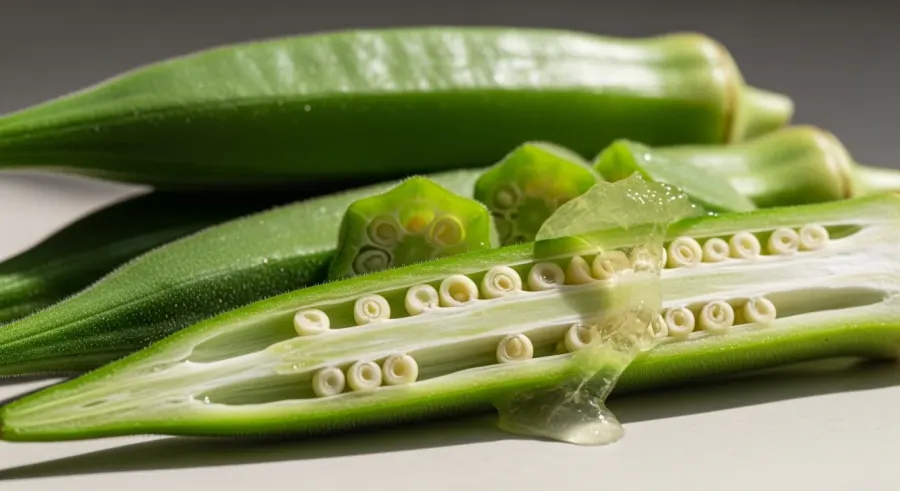
You have probably noticed that a whole, unblemished okra pod rarely feels slimy on the outside. But the moment you drag a blade through it, it turns into a sticky mess. This happens because of the pod's specific cellular anatomy.
The plant stores its mucilage in specialized parenchyma cells scattered throughout the walls of the pod. As long as those microscopic vaults remain intact, the gel stays completely contained. Slicing the okra ruptures thousands of these cells at once, spilling the exopolysaccharides out into the open.
Water acts as the immediate catalyst. When the exposed sugars touch even a tiny amount of moisture—like a rinsed cutting board, a damp hand, or condensation from the fridge—they instantly hydrate and swell. This rapid chemical reaction is why Southern cooks are notoriously careful to ensure their okra is completely bone-dry before chopping it. Adding water simply multiplies the volume of the gel.
Temperature and pH also manipulate the slime. Flash-frying okra at a very high heat seals the cut edges quickly, drying out the mucilage before it can spread. Conversely, slow wet heat, like boiling, initially pulls maximum slime out of the cells.
Acidity is one of the few things that can actually dismantle the gel. The acids found in tomatoes, vinegar, or lemon juice break the polysaccharide bonds apart over time, thinning the liquid out. This explains why a classic gumbo, which simmers chopped okra in an acidic tomato base for an extended period, ends up with a rich, thickened broth rather than a stringy texture. But the initial cut is always the trigger that sets the chemistry in motion.
When the Pods Turn to Wood
There is a distinct window of time when okra is harvested. If you leave a pod on the stalk for too long, it undergoes a drastic structural change. The mucilage starts to take a back seat to a much tougher compound: lignin.
As the seeds inside the pod mature, the plant stops focusing on water retention and starts focusing on protection. It builds thick, woody cell walls to encase the seeds, ensuring they can survive the winter and germinate the following year. This process, known as lignification, happens quite fast. An okra pod can go from tender to completely inedible in a matter of days. Once the lignin takes over, the pod becomes so fibrous that a kitchen knife can barely cut through it.
At this stage, the mucilage is still present, but the physical texture of the pod is ruined for culinary purposes. The woody fibers will not break down, no matter how long you boil them. This rapid shift in biology is why farmers must harvest okra when the pods are only a few inches long and still rely on the flexible mucilage for their structural integrity. It is a delicate balance between harvesting the pod when it is packed with soluble fiber, and waiting too long until it essentially turns into a tree branch.
The Slime of the Future
The very texture that makes some eaters squeamish has caught the full attention of material scientists. Because okra mucilage is entirely edible, highly viscous, and bonds easily with other molecules, researchers are finding applications for it far beyond the kitchen.
Currently, the commercial food industry is testing okra slime as a natural fat replacer in processed cheeses and gluten-free baked goods. Its unique ability to hold moisture mimics the rich mouthfeel of dairy fat without the caloric load. Pharmaceutical companies are also studying the dried mucilage as a binder for pills, using it to control the slow release of medication as it moves through the stomach.
The applications get even more futuristic. Recent studies have demonstrated that okra mucilage can be engineered into completely biodegradable packaging films. When the polysaccharides are extracted and dried, they form cohesive hydrogen bonds that are strong enough to rival the tensile strength of certain synthetic plastics. These films could eventually replace single-use food wrappers.
Environmental engineers are also testing the gel to clean water. Because the mucilage is so effective at binding to microscopic particles, it acts as a powerful natural bio-flocculant. When introduced to wastewater, it grabs onto floating toxins, heavy metals, and debris, clumping them together and pulling them to the bottom. This leaves clean, clear water behind without the need for harsh chemical flocculants. The exact same substance you might wipe off your kitchen knife in frustration could soon wrap your groceries or filter your drinking water.
Bottom Line
The next time your knife gets caught in a web of green gel, you don't need to wonder if you bought a bad batch. You are just looking at one of nature’s most efficient survival mechanisms doing exactly what it was designed to do. It kept the plant alive in the desert, and it just might end up wrapping our groceries in the future.