In Short
Cucumbers turn bitter when environmental stress like drought or heat forces them to produce defensive chemicals called cucurbitacins in the fruit. Why a popular internet trick to fix this doesn't actually work (and what the burpless label really means) is below.
We expect cucumbers to be the most harmless, refreshing thing in the kitchen. They are practically water dressed up in a green suit. According to USDA FoodData Central, a 100-gram serving of raw cucumber with the peel delivers 95.2 grams of water alongside just 15 calories, 3.63 grams of carbohydrates, and 0.65 grams of protein. You slice it into a salad or drop it into ice water, anticipating that crisp, clean flavor. But every now and then, you take a bite and are met with an aggressive, astringent chemical taste that ruins the entire dish. That sudden harshness doesn't mean the vegetable is rotting, and it isn't your fault for storing it incorrectly. The answer lies in a botanical defense mechanism.
The Plant Is Actually Trying To Survive
Wild cucumbers are practically inedible. If you were to stumble upon the ancient ancestors of our modern salad staples growing in the wild, you would spit out your first bite immediately. The bitterness you occasionally taste in garden-grown varieties today is just a faint, lingering echo of a biological defense system.
Cucumbers belong to the cucurbit family, a sprawling botanical group that includes pumpkins, melons, and gourds. For thousands of years, these plants have manufactured a class of complex chemicals called cucurbitacins. Biochemically, these are highly oxygenated tetracyclic triterpenes. In plain terms, they are custom-built poisons designed to make the plant taste so bad that passing herbivores leave it alone.
These compounds are naturally concentrated in the vegetative parts of the plant. The broad leaves, the hairy stems, and the deep roots are packed with cucurbitacins. When a foraging mammal takes a bite of the foliage, the sharp flavor acts as an immediate deterrent. The plant isn't trying to punish you for putting it in a salad; it is simply trying to protect its reproductive future.
Humans have spent millennia selectively breeding cucumbers to be palatable. We chose seeds from the mildest plants generation after generation, quieting the defense system, but we never entirely erased it. The capacity to produce these bitter chemicals is still written into the plant's DNA. Interestingly, while humans generally avoid the taste today, ancient traditional medicine in parts of Asia actually sought out these wild, bitter cucurbits, using their highly concentrated roots as purgatives.
Why Heat Waves Make It Worse
You might have noticed that early-season cucumbers taste beautifully sweet, but the ones you harvest in the sweltering late days of August carry a distinctly harsh bite. This timing is not a coincidence. Environmental stress dictates exactly how these chemicals accumulate through the plant's system.
According to the Purdue University Extension (2020), when a cucumber vine experiences severe environmental stress—like prolonged drought, extreme temperature spikes, or poor soil nutrition—it shifts into survival mode. The plant recognizes that its environment is failing. In response, it attempts to protect its developing seeds at all costs.
This stress triggers the vine to synthesize cucurbitacins directly in the fruit. If a vine goes too long without a steady supply of water (most experts recommend about 1 to 1.5 inches of slow, consistent watering per week), the defense mechanism kicks into high gear. The cucurbitacins accumulate in the cucumber, pooling heavily at the stem end where the fruit attaches to the vine.
They also concentrate just beneath the dark green skin. This is why you can sometimes take a bite from the center of a cucumber and find it perfectly mild, only to hit a wall of bitterness when you chew the edges. Greenhouse growers often use highly controlled drip irrigation systems specifically to eliminate this variable. In a backyard garden, however, the severity of the heat and drought directly correlates to the volume of bitter compounds produced in the fruit.
Wait, Does Milking A Cucumber Work?
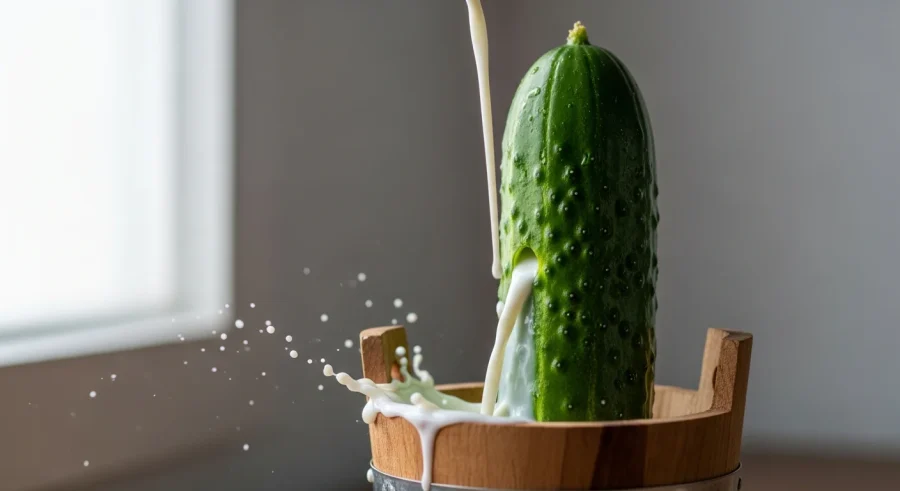
There is a persistent and highly visual internet trend claiming you can "milk" a cucumber to draw out the bitterness. You cut off the tip, rub it in a tight circular motion against the exposed flesh, and watch a thick, white, soapy foam appear.
The foam is entirely real. It is a physical mixture of water and cucurbitacin. These chemical compounds have saponin-like properties, meaning they foam up naturally when introduced to friction, water, and air. Watching the white sap gather on the edge of the slice makes it feel like you are actively extracting the bad flavor.
But the science behind this viral trick is flawed. Rubbing the ends together breaks the capillary walls at the very edge of the vegetable. It pulls out some of the bitter fluid from that highly localized, specific area. It does not act as a hydraulic vacuum for an eight-inch vegetable. You are only extracting the cucurbitacin from the exact spot you are rubbing.
Because we know that stress-induced cucurbitacins concentrate in the skin and the stem end anyway, playing with the tip of the cucumber is mostly a waste of time. You are much better off just peeling the vegetable deeply with a sharp peeler and slicing off a full inch from the stem end. Milking is a fun party trick to show someone in the kitchen, but it leaves plenty of bitterness resting right under the skin of the rest of the cucumber.
The Genetic Trick Behind Burpless Cukes
Have you ever stared at a seed packet or a grocery store display and wondered what exactly a "burpless" cucumber is? For a long time, the label just meant a grower had selectively bred the mildest, thinnest-skinned plants they could find. It was a marketing term masking a biological mystery.
The exact mechanism remained hidden until 2014, when a landmark study published in the journal Science finally mapped the genetic pathways responsible for the flavor. Researchers from the University of California, Davis, alongside the Chinese Academy of Agricultural Sciences, sequenced the plant's DNA. William Lucas, a professor of plant biology at UC Davis who co-authored the paper, noted that they identified two master regulator genes acting like on-off switches.
They called them the Bl gene, which controls bitterness in the leaves, and the Bt gene, which controls bitterness in the fruit. These transcription factors dictate where the cucurbitacin is produced.
Burpless cucumbers are simply varieties that carry a specific genetic mutation. They still possess the Bl gene, meaning their leaves remain bitter enough to fend off hungry insects in the garden. But their Bt gene is switched off. Because the biosynthetic pathway in the fruit is genetically locked, the plant cannot produce the bitter chemicals in the cucumber itself, no matter how much heat or drought it endures. When you buy a burpless variety, you are buying a vegetable with a broken panic button.
It's Not The Seeds Making You Burp
Ask someone why cucumbers cause indigestion, and they will almost always blame the seeds. Seedless varieties, like the long English cucumbers wrapped in shrink wrap to protect their thin skins, are frequently marketed as easier to digest. This reinforces a total misunderstanding of how the human stomach responds to this vegetable.
The seeds are completely innocent. The real culprit behind that lingering, uncomfortable burping sensation is cucurbitacin itself. The chemical is notoriously harsh on the human digestive tract. It irritates the stomach lining, and the body's natural response to that irritation is to produce gas.
When you buy a "burpless" cucumber, you aren't paying for a lack of seeds. You are paying for a genetic profile that lacks the irritant chemical.
Scraping the seeds out of a stressed, bitter garden cucumber won't save your stomach. The chemical is hiding in the green skin you left behind. In rare and severe cases involving wild gourds, consuming large amounts of cucurbitacin leads to a recognized medical condition called Toxic Squash Syndrome, causing severe cramps and nausea. The burping is just the mildest possible version of your body rejecting a defensive compound. If you want to avoid the burp, ignore the seeds and grab a vegetable peeler.
Bottom Line
Bitterness is simply a cucumber behaving exactly as nature intended. Understanding the chemistry behind that sudden harsh taste makes it a lot easier to manage a summer garden, and a lot easier to justify peeling off the skin when August rolls around.